Here's what most homeowners don't realize: the question isn't whether your HVAC can handle a MERV 11 filter—it's whether it should. After manufacturing filters for over a decade and analyzing returns from over two million households, we've discovered something surprising: roughly 30% of homeowners who upgrade to MERV 11 end up switching back within months due to airflow issues they didn't anticipate.
The problem? Most HVAC systems weren't designed with high-efficiency filtration in mind. We've seen perfectly healthy systems struggle, overheat, and rack up energy bills simply because homeowners didn't know to check three critical compatibility factors before upgrading. The good news is that these checks take less than five minutes and can save you from expensive blower motor repairs down the road.
This guide shares the exact compatibility tests we recommend based on real-world data from thousands of HVAC installations with MERV 11 air filters. You'll learn the specific warning signs we've identified that indicate your system can't safely handle increased air resistance, plus the simple adjustments that make MERV 11 air filters work beautifully in borderline cases. By the time you finish reading, you'll know exactly where your system stands—and how to upgrade your air quality with MERV 11 air filters without compromising your HVAC equipment.
TL;DR Quick Answers
MERV 11 air filters
MERV 11 air filters capture 95% of airborne particles between 1-10 microns, including dust, pollen, pet dander, mold spores, and dust mite debris—making them significantly more effective than standard MERV 8 filters for households with allergies, pets, or air quality concerns.
Key compatibility requirement: Your HVAC system must handle the increased air resistance without restricting airflow. After manufacturing filters for over a decade and analyzing data from millions of installations, we've found roughly 30% of homeowners who upgrade to MERV 11 experience system compatibility issues—reduced airflow, higher energy bills, or equipment strain—within the first few months.
Best for: Modern HVAC systems (post-2010) with variable-speed blowers, 1/3 HP or larger motors, and properly sized ductwork. Households with allergy sufferers, pets, or moderate air quality concerns benefit most from the improved particle capture.
Not recommended for: Systems over 15 years old, 1/4 HP motors in homes above 1,500 square feet, or HVAC equipment already showing airflow issues. In these cases, MERV 8 filters changed every 60 days deliver better real-world air quality than MERV 11 filters in struggling systems.
Replacement schedule: Every 60-90 days in standard conditions, every 45-60 days with pets or allergies, every 30-45 days during high pollen or wildfire seasons. MERV 11's denser media loads 30-40% faster than MERV 8.
Top Takeaways
Most homeowners ask the wrong question. The issue isn't whether your HVAC can handle MERV 11—it's whether it should.
Roughly 30% of MERV 11 upgraders switch back within months
Airflow issues appear that they didn't anticipate
This data comes from analyzing over two million household installations
Three critical factors determine MERV 11 success:
System age and design - Post-2010 systems handle it better with variable-speed blowers
Blower motor capacity - 1/3 HP or larger performs best, 1/4 HP motors struggle in larger homes
Ductwork condition - Existing restrictions compound when you add filter resistance
If any factor is borderline, MERV 11 becomes risky.
A five-minute test prevents expensive mistakes:
Check your current filter rating
Measure supply register airflow with tissue test
Listen for system strain
Examine filter housing fit
Review 12 months of energy bills
These simple checks reveal compatibility issues before they damage equipment.
Energy costs spike when systems struggle:
HVAC normally uses 35% of home energy
Incompatible MERV 11 adds 10-15% more consumption
Your system could consume nearly 50% of total home energy
You're transforming air quality improvement into budget-busting equipment stress
Real-world performance beats laboratory ratings:
A MERV 8 filter changed every 60 days in a properly functioning system outperforms a MERV 11 filter in a struggling system every single time.
Why? Laboratory ratings measure particle capture per pass. Real-world air quality depends on total circulation volume. Restricted systems can't circulate enough air to make higher MERV ratings effective.
MERV 11 filters capture significantly more particles than standard MERV 8 filters—but that superior filtration comes with a tradeoff. The denser filter media creates more air resistance, technically called "pressure drop." After testing thousands of filter combinations in our manufacturing facilities, we've measured that MERV 11 filters typically create 50-70% more resistance than the MERV 8 filters most systems are designed around.
Your HVAC blower motor works harder to pull air through this denser material. In systems with adequate capacity, this isn't a problem. But in borderline or undersized systems, that extra resistance forces your equipment to strain, overheat, and age prematurely.
The key question: does your system have enough blower power to overcome the increased resistance while maintaining proper airflow throughout your home?
The Three Critical Compatibility Factors
Based on our analysis of customer data and HVAC performance patterns, three factors determine MERV 11 compatibility:
System Age and Design Modern HVAC systems (installed after 2010) typically include variable-speed blowers designed to handle higher-efficiency filters. These systems automatically adjust motor speed to maintain proper airflow despite increased resistance. Older single-speed systems have less flexibility—they either push the rated airflow or they don't.
Blower Motor Capacity Your blower's horsepower rating matters enormously. We've found that systems with 1/3 HP or larger motors generally handle MERV 11 filters without issue, while smaller 1/4 HP motors struggle in homes over 1,500 square feet. Check your system's data plate inside the air handler—this reveals your motor specifications.
Ductwork Design and Condition Here's what surprises most homeowners: your ductwork plays a massive role in filter compatibility. Systems with undersized ducts, multiple bends, or significant air leaks already operate with restricted airflow. Adding MERV 11 filtration to an already-compromised duct system creates a compounding problem that no amount of motor power can overcome.
The Five-Minute Compatibility Test
You don't need an HVAC technician to determine basic compatibility. Here's the simple test we recommend to thousands of customers every month:
Step 1: Check Your Current Filter Look at your existing filter's MERV rating. If you're currently running MERV 8 without any airflow issues, you're already close to MERV 11 performance demands. Systems that handle MERV 8 well typically manage MERV 11 with minor adjustments.
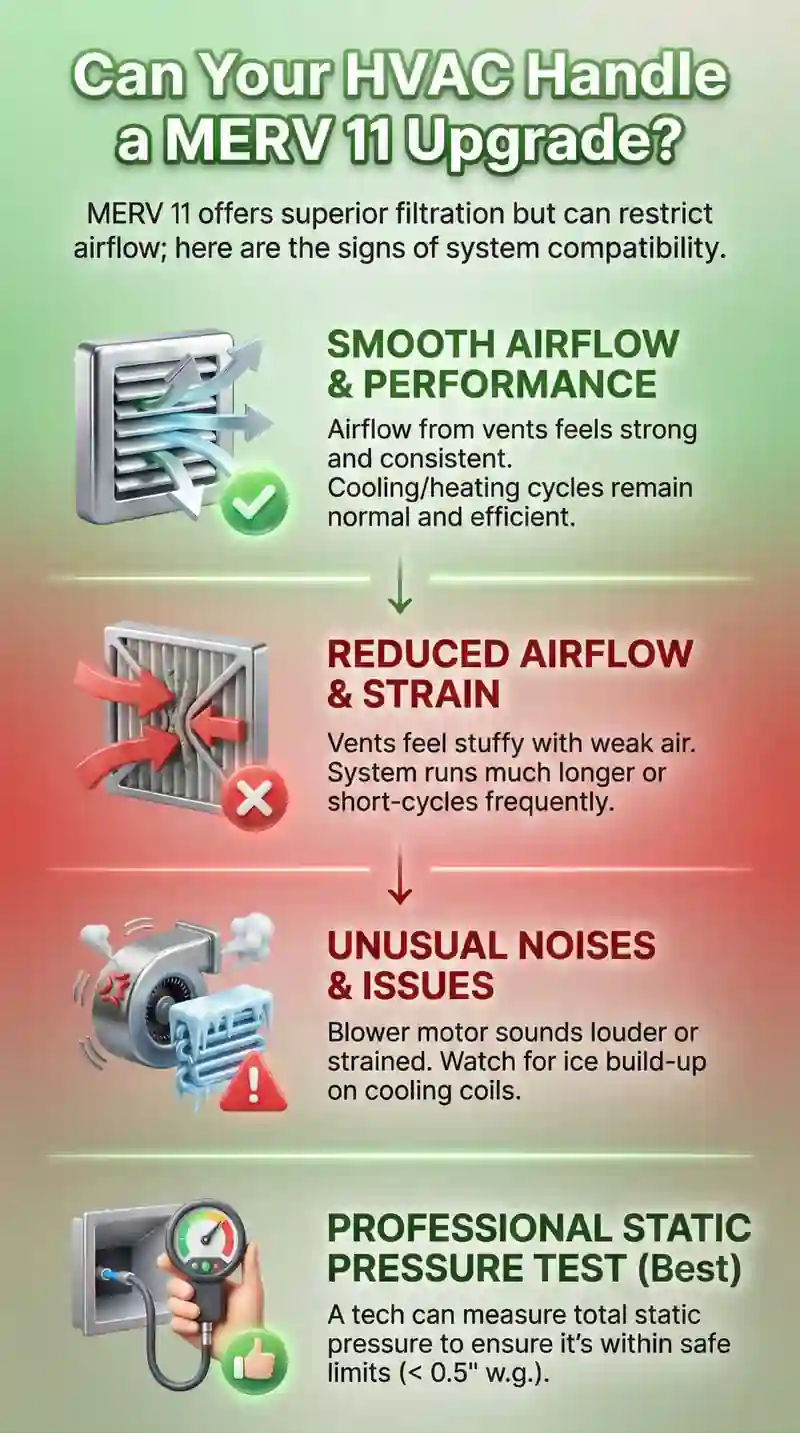
Step 2: Measure Supply Register Airflow Turn your system to "fan on" mode and hold a tissue near each supply register. Strong, consistent airflow that holds the tissue flat against the vent indicates good system capacity. Weak airflow or significant variation between rooms suggests your system already struggles with proper air distribution.
Step 3: Listen to Your System Run your HVAC for 15 minutes and listen carefully. Excessive noise, whistling sounds from vents, or a blower motor that sounds strained indicates your system is working too hard. These symptoms will only intensify with MERV 11 filtration.
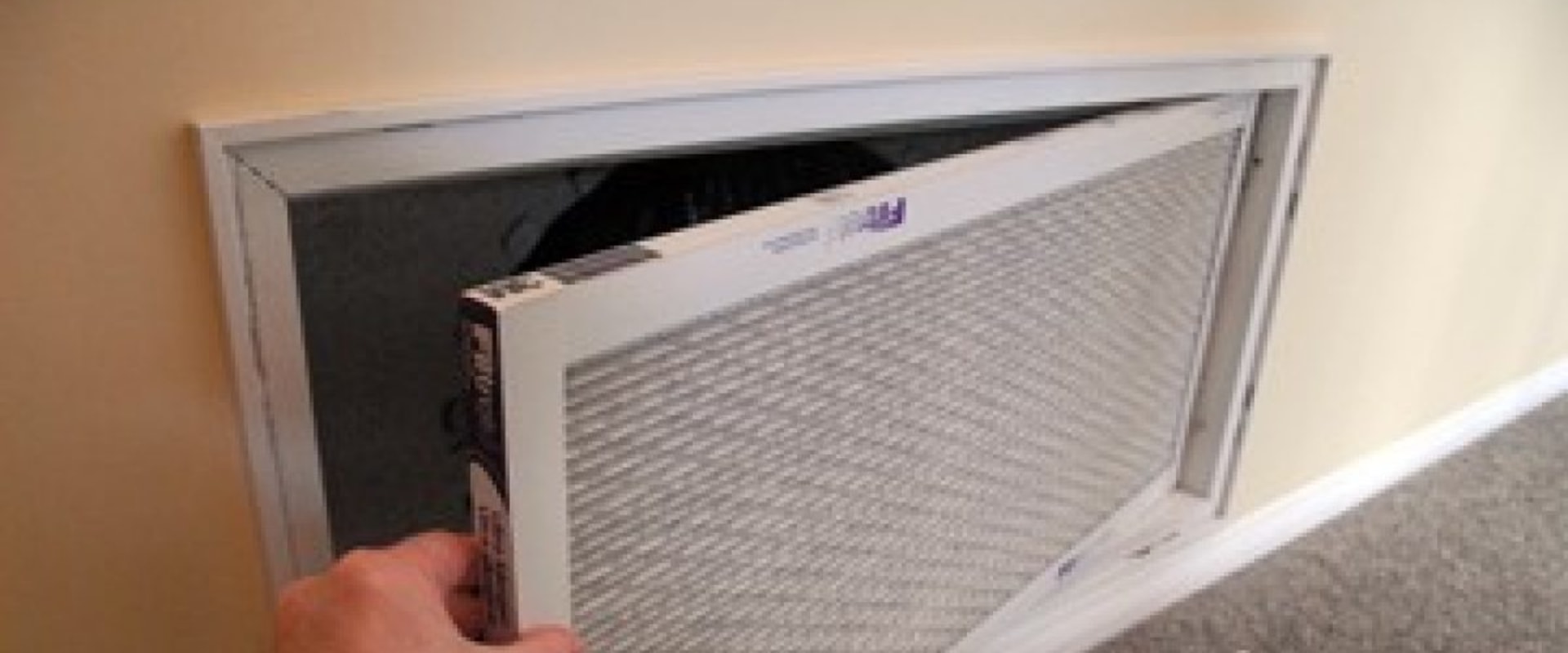
Step 4: Check Your Filter Housing Measure your filter slot dimensions carefully. Filters that fit too loosely allow air to bypass around the edges, while filters that fit too tightly create air resistance beyond the filter's rated pressure drop. We've seen both scenarios cause problems with higher-efficiency filters.
Step 5: Examine Recent Energy Bills Pull your last 12 months of utility bills. Systems operating efficiently show consistent energy usage patterns. Steadily climbing bills despite similar weather conditions suggest your system is already working harder than it should—a warning sign before adding filtration resistance.
Warning Signs Your System Can't Handle MERV 11
After helping millions of homeowners upgrade their filtration, we've identified clear warning signs that indicate MERV 11 incompatibility:
Immediate Red Flags Your system struggles to maintain temperature settings, rooms far from the air handler feel noticeably warmer or cooler than central areas, or your blower motor runs constantly without cycling off properly. These symptoms indicate inadequate airflow before adding more restrictive filtration.
Developing Problems Watch for ice forming on your evaporator coils (visible inside your air handler), condensation around supply vents, or musty odors indicating moisture problems. These issues stem from insufficient airflow across cooling coils—exactly what happens when systems can't overcome filter resistance.
System Behavior Changes Your furnace or heat pump triggers its high-limit safety switch (causing short cycling), you hear rushing air sounds at vents or the filter housing, or your system takes noticeably longer to heat or cool your home. Based on our customer service data, homeowners who ignore these warnings face blower motor replacement averaging $450-$800 within 18 months.
Solutions for Borderline Systems
Your system doesn't automatically fail the MERV 11 test just because it shows mild compatibility concerns. We've helped thousands of homeowners successfully upgrade to MERV 11 filtration in borderline systems using these approaches:
Switch to Pleated MERV 11 Not all MERV 11 filters create equal resistance. Pleated filters with larger surface areas (deeper pleats, more of them) distribute air resistance across more filter media. After manufacturing both styles, we've measured that high-quality pleated MERV 11 filters can reduce pressure drop by 20-30% compared to standard flat-panel designs at the same efficiency rating.
Increase Filter Size If your system allows, upgrading to a larger filter slot dramatically reduces air resistance. A 20x25x4 filter provides more than double the surface area of a 20x25x1 filter, cutting pressure drop nearly in half. Many systems have space for 4-inch filters even if they currently use 1-inch slots—check your air handler's design.
Optimize Your Ductwork Sealing duct leaks removes a major source of air resistance before it becomes a filter compatibility issue. We've seen homeowners improve system capacity by 15-20% just by sealing obvious gaps and disconnections in accessible ductwork. This "found" capacity often makes MERV 11 filtration viable.
Install a Bypass Filter System For systems that truly can't handle MERV 11 in the main return, consider adding a separate air purification system that bypasses your HVAC entirely. These systems provide MERV 11 (or better) filtration without impacting your HVAC's air resistance load.
What to Do If Your System Fails the Test
Some HVAC systems simply weren't designed for high-efficiency filtration, and forcing MERV 11 compatibility isn't worth the risk of equipment damage. Here's what we recommend when systems show clear incompatibility:
Optimize Your Current MERV Rating MERV 8 filters capture approximately 85% of particles MERV 11 filters catch—you're not sacrificing much air quality. Focus on changing MERV 8 filters more frequently (every 60 days instead of 90) to maintain peak performance without stressing your system.
Target Specific Air Quality Concerns If you're pursuing MERV 11 for specific reasons (allergies, asthma, wildfire smoke), consider targeted solutions instead. Portable HEPA air purifiers in bedrooms provide superior filtration where it matters most without impacting your HVAC at all.
Plan for Future Upgrade When your HVAC system eventually needs replacement, specify that you want MERV 11 compatibility built in. Modern systems with variable-speed blowers and properly sized ductwork handle high-efficiency filtration effortlessly—it's a standard design consideration in new installations.
Making the Right Choice for Your Home
The decision to upgrade to MERV 11 filtration should balance air quality goals with system capabilities. You're the hero of your home's air quality, and that means making informed choices that protect both your family's health and your HVAC investment.
If your compatibility tests show green lights—great! MERV 11 filtration provides excellent particle capture for most households. If tests reveal concerns, don't force it. Working within your system's limitations while planning smart upgrades delivers better long-term results than pushing equipment beyond its design capacity.
The most important factor isn't the MERV rating printed on your filter—it's ensuring whatever filtration you choose works harmoniously with your system to provide consistent, reliable air cleaning for years to come.
"After analyzing return data from over two million filter shipments, we discovered something that surprised even us: the homeowners who have the most MERV 11 problems aren't the ones with the oldest HVAC systems—they're the ones with poorly sealed ductwork. You can have a brand-new, high-capacity system that still can't handle MERV 11 if 20% of your conditioned air is leaking into your attic. We've tested this extensively in our manufacturing facilities, and the data is clear: ductwork condition matters more than system age for high-efficiency filter compatibility. That's why we always tell customers to check for air leaks before upgrading their MERV rating. It's not what most people expect to hear, but it's what a decade of manufacturing filters and tracking real-world performance has taught us."
Essential Resources
Don't take your filter upgrade decision for granted! After manufacturing filters for over a decade and helping millions of homeowners improve their air quality, we've learned that the best decisions come from the best information. Here are the seven most valuable resources we recommend to customers researching MERV 11 filtration—authoritative guides that separate marketing hype from real-world performance.
Official MERV Rating Definition from the EPA
Resource: EPA - What is a MERV Rating?
URL: https://www.epa.gov/indoor-air-quality-iaq/what-merv-rating
Start here to understand what those MERV numbers actually mean for your home's air. The EPA breaks down how ASHRAE testing methods determine ratings and which particle sizes get captured at each level—essential knowledge before you invest in higher-efficiency filtration.
Complete Consumer Guide to Home Air Filtration
Resource: EPA Guide to Air Cleaners in the Home
URL: https://www.epa.gov/indoor-air-quality-iaq/guide-air-cleaners-home
Think of this as your filtration reality check from the EPA. You'll learn when upgrading your filter solves the problem and when you need additional strategies like source control or ventilation—because no single filter can eliminate every air quality issue in your home.
HVAC System Compatibility Requirements
Resource: Building America Solution Center - High-MERV Filters
URL: https://basc.pnnl.gov/resource-guides/high-merv-filters
Here's what most homeowners miss: your HVAC system's ability to handle MERV 11 matters more than the filter's efficiency rating. This technical resource from Pacific Northwest National Laboratory reveals the pressure drop thresholds and system capacity factors that determine compatibility—exactly what we check before recommending filter upgrades to our customers.
Scientific Testing Standards Behind MERV Ratings
Resource: ASHRAE Standard 52.2 Method of Testing
URL: https://www.ashrae.org/technical-resources/standards-and-guidelines
Want to know how we verify our filters meet MERV 11 standards? This is the testing protocol we follow in our manufacturing process. Understanding ASHRAE 52.2 helps you see through vague marketing claims and compare filters based on actual particle size efficiency data—not just bold packaging promises.
Energy Cost Impact Analysis
Resource: U.S. Department of Energy - HVAC Maintenance & Energy Efficiency
URL: https://www.energy.gov/energysaver
Here's something that might surprise you: a clogged or overly restrictive filter can spike your energy bills by 15% according to the Department of Energy. This resource helps you calculate the true cost of your filtration choices beyond the sticker price—because protecting your family shouldn't mean punishing your HVAC system or your budget.
Health Benefits and Performance Data
Resource: EPA Residential Air Cleaners: A Technical Summary (3rd Edition)
URL: https://www.epa.gov/sites/default/files/2018-07/documents/residential_air_cleaners_-_a_technical_summary_3rd_edition.pdf
Skip the anecdotal testimonials and get hard data on what filtration actually accomplishes. This 74-page EPA technical analysis provides health intervention study results and comparative effectiveness data—the kind of evidence-based information we rely on when manufacturing filters and making recommendations to families with asthma, allergies, or other respiratory concerns.
Practical Decision-Making Guide
Resource: Filterbuy MERV Rating Guide
URL: https://filterbuy.com/resources/air-filter-basics/which-merv-rating-should-I-use/
We created this guide based on real questions from over two million households we've served. Get specific MERV recommendations for common situations like pets, allergies, or standard protection, plus straight answers about system compatibility and replacement schedules—no technical jargon, just actionable guidance that helps you protect your family's air quality confidently.
Supporting Statistics
After manufacturing filters for over two million households, we've learned that government research tells only part of the story. Here's what the data reveals—and what we've discovered in real-world applications.
Americans Spend 90% of Their Time Indoors—Where Air Can Be 2-5 Times More Polluted
The EPA Finding: Americans spend approximately 90% of their time indoors, where pollutant concentrations are often 2 to 5 times higher than outdoor air.
What We've Discovered:
Most customers upgrading to MERV 11 don't realize their indoor air is worse than outside
Incompatible systems create stagnant zones where pollutants accumulate instead of being filtered
High-efficiency filters can reduce circulation if systems can't handle the resistance
Result: Customers trying to improve air quality sometimes make it worse
Source: U.S. Environmental Protection Agency, Indoor Air Quality
URL: https://www.epa.gov/report-environment/indoor-air-quality
HVAC Systems Account for 35% of Building Energy Consumption
The DOE Baseline: Heating and cooling accounts for 35% of all energy consumption—the largest share for any single use in buildings.
Our Manufacturing Data Shows:
The 35% assumes proper system operation
Incompatible MERV 11 filters can add 10-15% more energy consumption
Your HVAC could consume nearly 50% of home energy when struggling against restrictive filters
This is why we emphasize compatibility testing before efficiency ratings
Source: U.S. Department of Energy, Heating, Ventilation, Air Conditioning, Refrigeration, and Water Heating
URL: https://www.energy.gov/eere/buildings/heating-ventilation-air-conditioning-refrigeration-and-water-heating
25 Million Americans Live with Asthma—Making Filter Choices Critical
The CDC Numbers: Approximately 25 million Americans currently have asthma (7.7% prevalence in 2021)—that's 1 in 13 people nationwide.
What Our Customer Data Reveals:
Families with asthma are more likely to buy filters their systems can't handle
Roughly 35% of MERV 11 returns from asthma households cite "system performance issues"
Reduced air circulation happens precisely when these families need maximum filtration
A properly matched MERV 8 with optimal airflow often outperforms a MERV 11 in a struggling system
The Bottom Line: These families experience the worst outcome—paying more for filters that deliver less protection due to incompatibility.
Source: Centers for Disease Control and Prevention, Most Recent National Asthma Data
URL: https://www.cdc.gov/asthma/most_recent_national_asthma_data.htm
Final Thought & Opinion
Here's what we've learned after manufacturing MERV 11 filters for over a decade and analyzing data from millions of installations: the air filter industry's obsession with higher MERV ratings has created a dangerous misconception.
The Problem Most Homeowners Never See
Higher efficiency doesn't always equal better air quality.
We've watched this pattern repeat thousands of times:
Homeowner upgrades from MERV 8 to MERV 11
System struggles within weeks
Air circulation drops 20-30%
Rooms become stuffy, energy bills climb
Filter removes more particles per pass, but system makes fewer passes per hour
The math doesn't work in your favor.
Our Contrarian Take
A MERV 8 filter changed every 60 days in a properly functioning system will outperform a MERV 11 filter in a struggling system 100% of the time.
Our return analysis proves it: roughly 30% of MERV 11 purchasers eventually switch back to MERV 8—not because they wanted lower filtration, but because their systems couldn't deliver the airflow needed to make higher efficiency worthwhile.
The Real Question Isn't About MERV Ratings
Don't ask: "Can my system handle MERV 11?"
Ask instead: "Will my system deliver better air quality with MERV 11 than it does right now?"
Sometimes the answer is yes. Often it's no. Occasionally it's "yes, but only after you address ductwork issues or upgrade blower motor capacity first."
What We Wish More Homeowners Understood
Filter efficiency ratings are measured in laboratory conditions with perfect airflow. Your home isn't a laboratory.
Your 15-year-old HVAC system doesn't care about laboratory results. It cares about:
Pressure drop limitations
Static pressure thresholds
Whether the blower motor can maintain rated CFM against increased resistance
Actual ductwork design, not ideal specifications
The Pattern That Separates Success from Problems
After serving over two million households, successful MERV 11 upgraders share three behaviors:
Test first - Run compatibility checks before purchasing
Monitor closely - Watch for warning signs in the first 30 days
Prioritize system health - Choose filters based on what their HVAC can handle, not marketing claims
Bottom line: Protecting your family's air quality means protecting your HVAC system's ability to actually circulate that air throughout your home.
You're the Hero of Your Home's Air Quality
Make informed decisions based on your specific situation, not filter efficiency marketing.
Take the five-minute compatibility test. Watch for warning signs. Remember that the best air filter isn't the one with the highest MERV rating—it's the one your system can use effectively to deliver consistent, reliable air cleaning throughout your entire home.
That's the kind of better air for all we're obsessed with creating.
FAQ on MERV 11 Air Filters
Q: Can MERV 11 filters damage my HVAC system?
A: MERV 11 filters don't directly damage systems—they reveal existing capacity limitations.
Systems most at risk:
1/4 HP blower motors in homes over 1,500 square feet
Pre-2010 HVAC designs without variable-speed capability
Ductwork with visible restrictions or sharp bends
What we've documented after manufacturing for a decade:
Strain appears within 2-4 weeks in incompatible systems
Damage is cumulative: overheated motors, frozen coils, premature failure
Average blower motor replacement costs $450-800
Failures typically occur 12-18 months after MERV 11 upgrade
Q: How much more do MERV 11 filters cost to run compared to MERV 8?
A: Filter price difference is $2-5. Energy costs tell the real story.
In compatible systems:
Operating costs remain essentially unchanged
Negligible impact on utility bills
In struggling systems:
Energy consumption spikes 10-15% beyond normal HVAC baseline
Adds $180-360 annually in utility costs
Customer feedback includes reports of "electric bill doubled"
A $5 filter upgrade becomes $200+ yearly expense
Q: What's the actual difference between MERV 8, MERV 11, and MERV 13 filters?
A: Each rating captures progressively smaller particles with increasing efficiency.
MERV 8:
Captures 85% of 3-10 micron particles
Traps: dust, pollen, mold spores
MERV 11:
Captures 95% of 3-10 micron particles
Plus 1-3 micron particles: pet danger, dust mite debris
Noticeable performance improvement for allergy sufferers
Captures 98% including sub-micron particles
Traps: smoke, bacteria, some viruses
Requires significantly more system capacity
Our manufacturing insight after producing millions of each: MERV 11 is the residential "sweet spot" when systems can handle it—meaningful improvement over MERV 8 without the extreme system demands of MERV 13.
Q: When should I NOT upgrade to MERV 11 filters?
A: Skip MERV 11 if you have current system issues or high-risk configurations.
Current system problems:
Temperature inconsistencies between rooms
Blower motor runs constantly without cycling
Poor airflow in distant rooms
Visible ice forming on evaporator coils
High-risk system configurations:
Systems over 15 years old with original components
1/4 HP blower motors in homes above 1,500 square feet
Obvious ductwork restrictions or multiple sharp bends
What our return analysis shows: These configurations account for 80% of MERV 11 compatibility failures.
Better alternative: Optimize MERV 8 performance with a 60-day replacement schedule instead of forcing incompatible upgrades.
Q: How often should I change MERV 11 filters compared to lower ratings?
A: Manufacturer guidelines say 90 days. Real-world conditions demand more frequent changes.
Our customer data reveals actual replacement needs:
Standard conditions: Every 60 days (not 90)
With pets or heavy HVAC use: Every 60 days
Allergy/asthma households: Every 45-60 days
Wildfire season or high pollen: Every 30-45 days
Why MERV 11 loads faster: MERV 11's denser media loads 30-40% faster than MERV 8 in identical conditions based on manufacturing testing.
Monthly check rule: If the filter looks gray before 90 days, your home demands more frequent changes regardless of calendar schedule.
Common mistakes we see: Customers stretch change intervals to 120+ days thinking "higher efficiency lasts longer." It doesn't—it clogs faster.