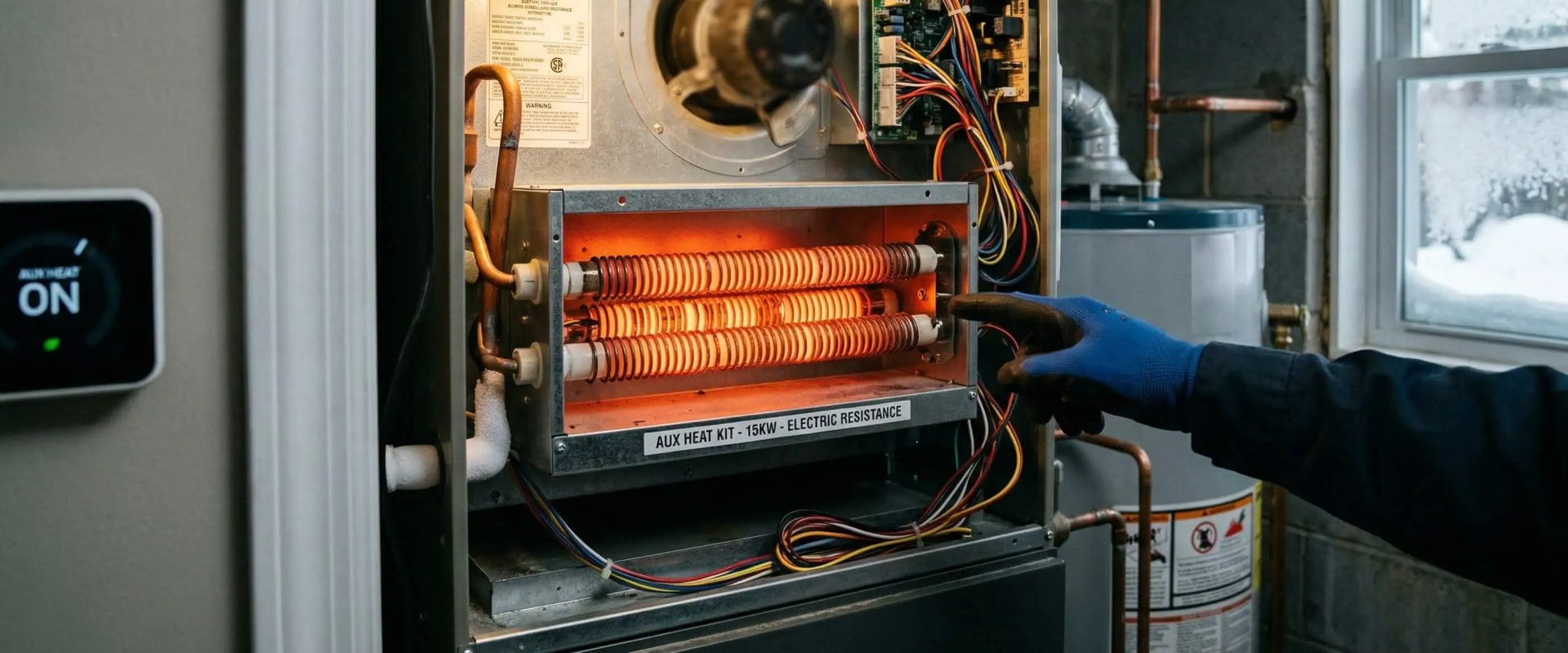
What surprises most homeowners is that what does auxiliary heat mean often has a reassuring answer: seeing "Aux Heat" usually means your system is working exactly as designed. This page explains what auxiliary heat means, how it supports your heat pump, how it differs from emergency heat, and what — if anything — you should do when it appears.
TL;DR Quick Answers
What Does Auxiliary Heat Mean?
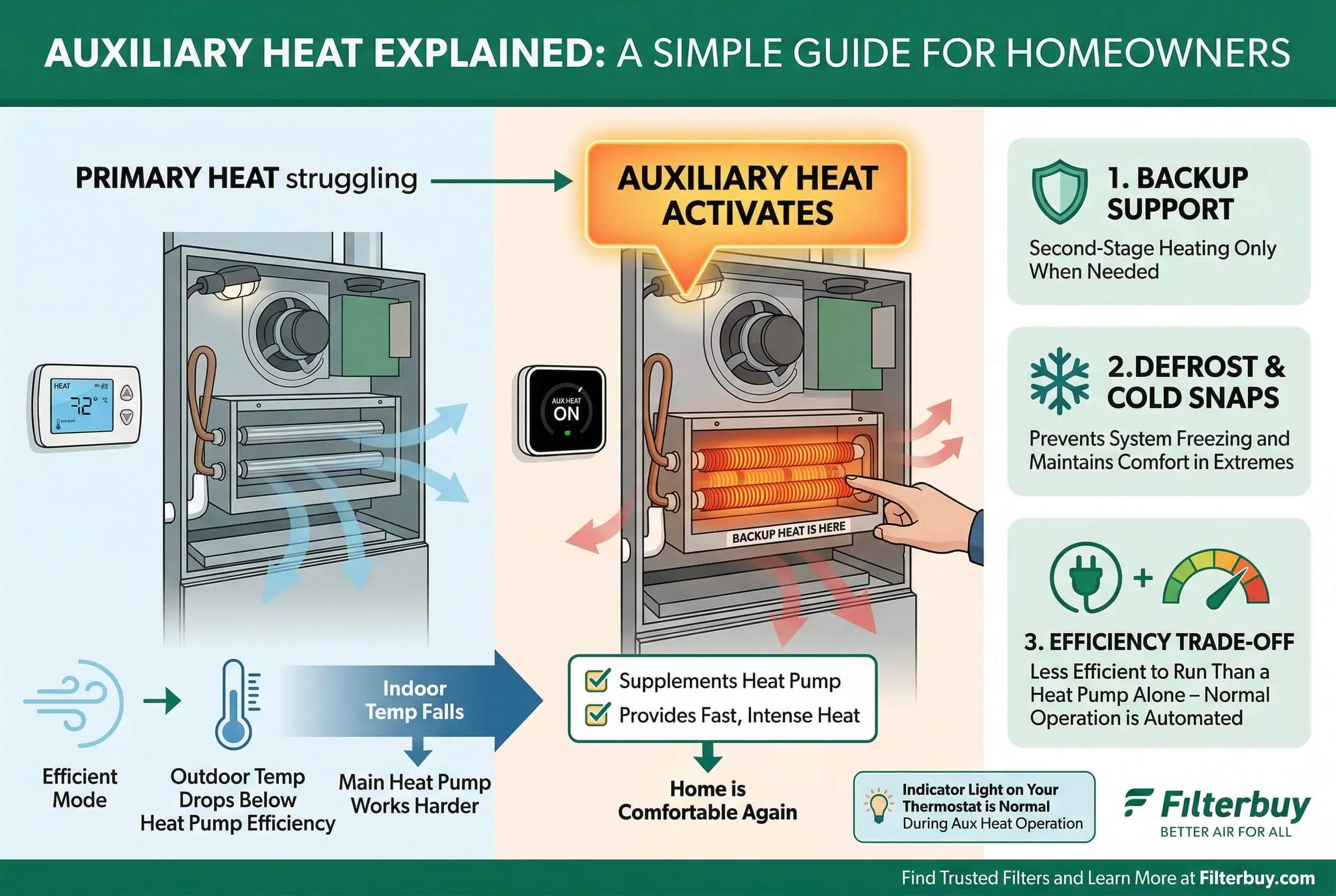
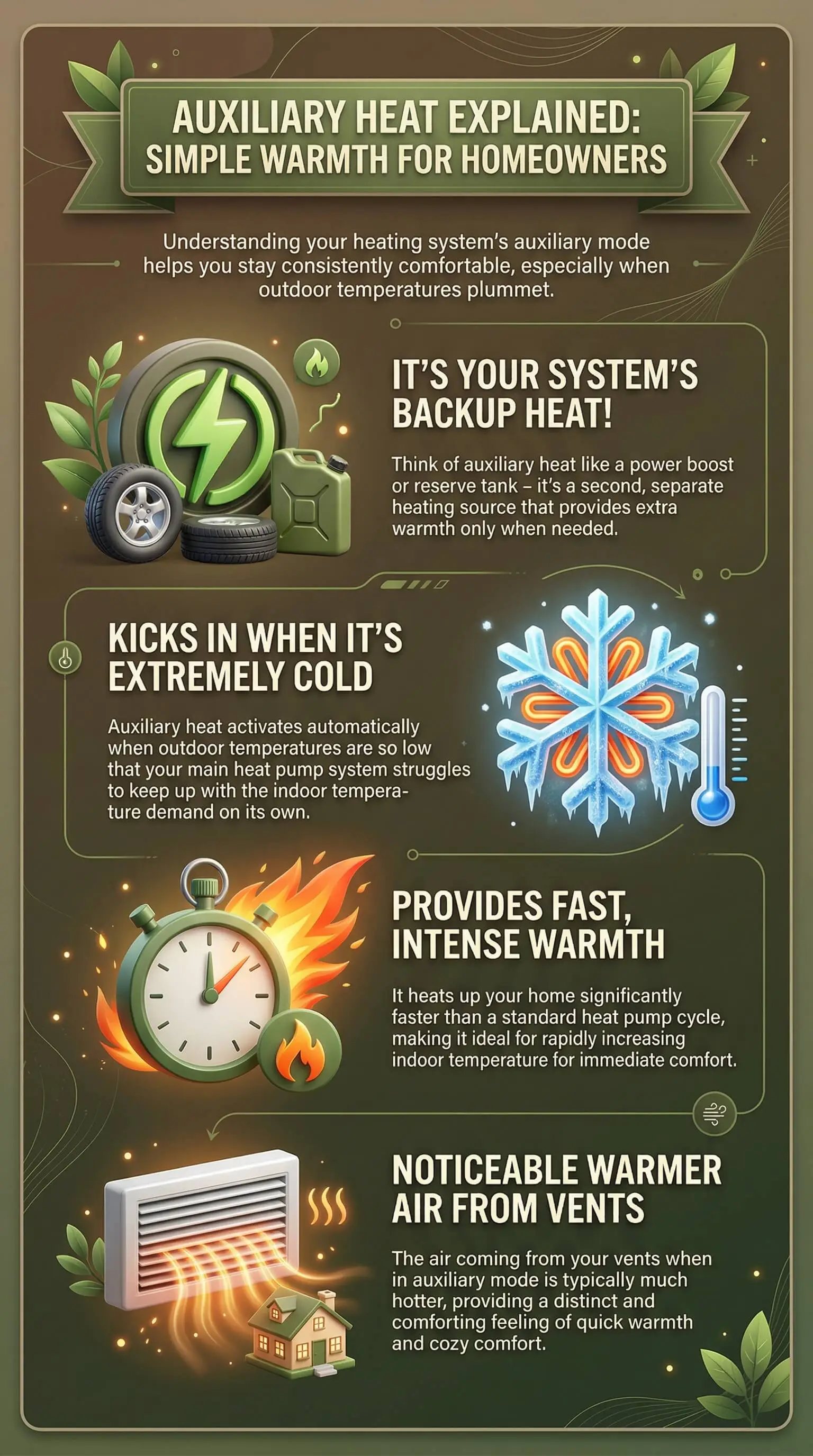
Auxiliary heat is your heat pump's automatic backup heating system. It activates on its own when outdoor temperatures drop too low for your heat pump to maintain your set temperature alone. Here is what you need to know:
"Aux Heat" on your thermostat is not an error — it means your system is working correctly
Auxiliary heat uses electric resistance coils housed inside your air handler
It activates automatically — you do not control it manually
It is normal during cold weather or after a large thermostat adjustment
It becomes a concern only when it runs constantly or activates during mild temperatures
In our experience working with more than two million households, the most common cause of excessive auxiliary heat is a dirty air filter — not a system failure. Check your filter before anything else.
The bottom line: Auxiliary heat is a built-in backup, not a problem. Short bursts are normal. Persistent operation is a signal. A clean filter, gradual thermostat adjustments, and an annual tune-up are the three most effective ways to keep backup heat where it belongs — in the background.
Top Takeaways
"Aux Heat" is not an error — it's confirmation your system is working. Auxiliary heat activates automatically when outdoor temperatures drop too low for your heat pump to manage alone. It means your system is functioning exactly as designed.
Auxiliary heat and emergency heat are not the same thing. Auxiliary heat supports your heat pump automatically. Emergency heat bypasses it entirely — manually. Confusing the two is an expensive mistake reserved for true system failures only.
Persistent auxiliary heat is a signal worth acting on. Normal: occasional backup heat during cold weather. Not normal: auxiliary heat running constantly or activating during mild temperatures. Most likely cause: a dirty air filter.
Your air filter has a direct line to your heating bill. A clogged filter:
Restricts airflow
Reduces heat pump capacity
Forces premature auxiliary heat activation
The U.S. Department of Energy confirms a clean filter can lower energy consumption by 5% to 15%. Check the filter before calling a technician.
Heat pumps are up to 75% more efficient than electric resistance heating. Auxiliary heat coils are electric resistance elements. Every minute your system runs on backup heat, that efficiency advantage disappears. A clean filter, such as a MERV 8 filter, gradual thermostat adjustments, and an annual tune-up keep backup heat where it belongs — in the background.
What Auxiliary Heat Actually Is
Auxiliary heat is a secondary heating element built into heat pump systems — typically a set of electric resistance coils housed inside your air handler. It exists for one reason: to support your heat pump when outside temperatures get too cold for it to extract enough warmth from the outdoor air on its own.
Heat pumps are remarkably efficient under normal conditions, but they have a limitation. When outdoor temperatures fall below a certain threshold — often somewhere between 30°F and 40°F depending on the system — the heat pump's output alone may not be enough to reach or maintain your set thermostat temperature. That's the exact moment auxiliary heat activates.
What "Aux Heat" on Your Thermostat Means
When you see "Aux Heat" displayed on your thermostat, your system has automatically switched on the electric resistance backup coils to supplement the heat pump. This is not an error. It's not a sign of damage. It's your HVAC system doing precisely what it was engineered to do, and understanding this can help you make confident, informed HVAC repair decisions while keeping your home comfortable and your system performing at its best.
In our experience working with homeowners across millions of households, this indicator causes unnecessary alarm more often than any other thermostat message. The system is healthy. It's compensating for conditions that are simply outside the heat pump's efficient operating range.
Auxiliary Heat vs. Emergency Heat: A Critical Difference
This is where a lot of homeowners get tripped up, and it's a distinction worth understanding clearly.
Auxiliary heat activates automatically. Your thermostat triggers it on its own when the heat pump needs backup. You don't control it directly.
Emergency heat is a manual setting. When you switch to emergency heat mode, you're deliberately bypassing the heat pump entirely and running only on the backup electric coils.
Emergency heat exists for situations where the heat pump itself is malfunctioning — a refrigerant leak, a frozen outdoor unit that won't defrost, or a compressor failure. Running emergency heat under normal conditions is significantly more expensive because you lose the efficiency of the heat pump altogether.
A simple rule: if you see "Aux Heat" on your thermostat during cold weather, leave it alone. If you've manually switched to "Em Heat" and it isn't a true emergency, switch back.
Why Auxiliary Heat Affects Your Energy Bill
Auxiliary heat uses electric resistance coils, which are far less energy-efficient than the heat pump itself. A heat pump can deliver two to three times more heat energy than the electricity it consumes. Electric resistance coils operate at roughly a 1:1 ratio — one unit of electrical energy in, one unit of heat out.
This means extended auxiliary heat operation during prolonged cold snaps will show up on your energy bill. That's normal and expected. What isn't normal is if your "Aux Heat" indicator stays on constantly — even during mild weather. That's a signal worth paying attention to.
When Auxiliary Heat Running Constantly Is a Problem
Occasional auxiliary heat operation is part of normal system function. Persistent auxiliary heat — especially when outdoor temperatures aren't particularly low — may point to an underlying issue. Common causes include:
A dirty or clogged air filter restricting airflow and reducing system efficiency
Low refrigerant levels limiting the heat pump's heating capacity
A malfunctioning outdoor unit or defrost cycle issue
An undersized heat pump that can't adequately handle your home's heating load
After manufacturing HVAC-grade air filters for over a decade and serving more than two million households, we've seen a dirty filter quietly push systems into auxiliary heat mode far more often than homeowners expect. It's one of the simplest and most overlooked contributors to HVAC inefficiency. Checking and replacing your air filter is always the right first step before calling a technician.
"Homeowners are often surprised to learn that 'Aux Heat' is one of the most misunderstood messages a thermostat can display — and one of the most harmless. After working with more than two million households, we've found that the bigger concern isn't the auxiliary heat itself, it's what's causing it to run longer than it should. Nine times out of ten, a neglected air filter is quietly forcing the system to lean on its backup heat more than necessary. That single maintenance step — swapping a clogged filter for a clean one — can bring a heat pump back into its efficient operating range before a technician ever needs to get involved."
Essential Resources
We want you to feel confident about what your system is doing — and why. These trusted resources helped shape our understanding of auxiliary heat, and we think they'll help you too. Each one is worth bookmarking if you want to go deeper.
1. The Government's Plain-Language Guide to How Heat Pumps Work U.S. Department of Energy — Heat Pump Systems
If you want to understand why auxiliary heat exists in the first place, start here. The Department of Energy explains how heat pumps move warmth from outdoor air into your home — and why that process needs backup support when temperatures drop too low.
https://www.energy.gov/energysaver/heat-pump-systems
2. Federal Standards That Tell You What a Good Heat Pump Should Do ENERGY STAR — Air-Source Heat Pumps
ENERGY STAR sets the bar for heat pump performance, backup heat recommendations, and filter maintenance best practices. This is a reliable, government-backed resource for homeowners who want to know whether their system measures up — and what they can do to help it run more efficiently.
https://www.energystar.gov/products/air_source_heat_pumps
3. When Aux Heat Turns On — and What to Watch For Trane — What Is Auxiliary Heat in a Heat Pump System?
Trane walks through the specific conditions that trigger auxiliary heat, how dual-fuel systems behave differently from standard heat pump setups, and simple steps you can take to reduce unnecessary backup heat use. A practical read if you want to know whether what you're seeing on your thermostat is normal.
https://www.trane.com/residential/en/resources/blog/heat-pump-auxiliary-heat/
4. What Your Thermostat Is Actually Telling You Lennox — What Does AUX Heat Mean?
Your thermostat's aux heat indicator is more than a notification — it can be an early sign that something needs attention. Lennox explains how thermostats detect temperature lag, trigger backup heat, and signal when your system may need a professional look. Good to read before you start worrying or before you call for service.
https://www.lennox.com/residential/lennox-life/consumer/what-does-aux-heat-mean
5. Auxiliary Heat vs. Emergency Heat — Know the Difference Before You Touch That Setting American Standard — What Is Aux Heat?
We see this confusion all the time. Auxiliary heat turns on automatically to support your heat pump. Emergency heat is a manual override that shuts your heat pump down entirely. Using emergency heat when you don't need to costs significantly more and puts unnecessary strain on your system. This resource clears it up.
https://www.americanstandardair.com/resources/blog/what-is-aux-heat/
6. How Auxiliary Heat Affects What You Pay Each Month Carrier — What Is Auxiliary Heat?
If your energy bill crept up this winter and you're not sure why, auxiliary heat may be part of the answer. Carrier breaks down when backup heat activates, how much more electricity it uses compared to your heat pump, and what thermostat habits can help you keep those costs in check.
https://www.carrier.com/residential/en/us/homeowner-resources/hvac-glossary/what-is-auxiliary-heat/
7. Does Where You Live Determine How Much Backup Heat You Need? Bryant — What Is Auxiliary Heat? How It Works and Why It Matters
The answer is yes — and this resource explains why. Bryant covers how your local climate affects how often auxiliary heat runs, whether a dual-fuel system makes more financial sense for your home, and the real cost gap between auxiliary heat and emergency heat operation. Worth reading if you're evaluating your long-term heating setup.
https://www.bryant.com/en/us/about-bryant/glossary/what-is-auxiliary-heat/
These trusted resources helped shape our understanding of auxiliary heat and show how proper HVAC maintenance can support heat pump performance, reduce unnecessary backup heat use, and help homeowners make confident decisions.
Supporting Statistics
After manufacturing HVAC-grade air filters for over a decade and working with more than two million households, we've seen firsthand how auxiliary heat misuse quietly inflates energy bills — often without homeowners realizing the connection. These three government-sourced statistics help explain why.
Heat Pumps Deliver Up to 75% Savings Over Electric Resistance Heating
Not all heat is created equal — and the difference shows up on your bill.
Today's heat pump can reduce electricity use for heating by up to 75% compared to electric resistance heating such as furnaces and baseboard heaters. Department of Energy
Auxiliary heat coils are electric resistance elements — the same technology sitting at that 75% efficiency disadvantage.
Every minute your system runs on backup heat instead of heat pump operation, that gap widens.
Homeowners who understand this relationship manage their heating costs with confidence. Those who don't are often surprised every winter.
Source: U.S. Department of Energy — Heat Pump Systems https://www.energy.gov/energysaver/heat-pump-systems
A Dirty Filter Can Raise Energy Consumption by Up to 15%
This is the statistic we reference most often — because we've seen the pattern repeat across thousands of homes.
Replacing a dirty, clogged filter with a clean one can lower your air conditioner's energy consumption by 5% to 15%. Department of Energy
Restricted airflow from a neglected filter forces a heat pump beyond its capacity.
That strain triggers auxiliary heat earlier and more often than outdoor temperatures alone would justify.
In our experience, checking the filter is always the right first step before assuming a problem requires a service call. More often than not, the filter is doing the damage.
Source: U.S. Department of Energy — Maintaining Your Air Conditioner https://www.energy.gov/energysaver/maintaining-your-air-conditioner
Nearly Half of Every Home Energy Dollar Goes to Heating and Cooling
The homeowners we work with every day are focused on the right things — filter changes, thermostat habits, seasonal tune-ups. The data backs that instinct.
Nearly half of the energy used in your home goes to heating and cooling. ENERGY STAR
That makes your heat pump system the single biggest energy variable in your home.
Keeping auxiliary heat in a supporting role — not a primary one — is one of the highest-impact decisions you can make.
It's not just a system health issue. It's a direct line to what you spend on energy every month.
Source: ENERGY STAR — Heat and Cool Efficiently https://www.energystar.gov/saveathome/heating-cooling
Final Thoughts
Auxiliary heat looks complicated on the surface. It isn't. Your heat pump has limits. Auxiliary heat covers those limits — automatically, quietly, and by design. Seeing "Aux Heat" on your thermostat isn't a warning. It's your system doing exactly what it was built to do.
That said, here's where our perspective differs from what most homeowners hear.
Auxiliary heat isn't the problem — it's the messenger.
After working with more than two million households, we've learned to read what backup heat is actually communicating:
Runs occasionally during a cold snap — your system is healthy
Runs constantly or activates during mild weather — your system is signaling an issue
The real question isn't whether aux heat is bad. It's whether it's running more than your conditions actually require.
The answer almost always starts with the air filter.
Not the thermostat. Not the refrigerant. Not the outdoor unit. The filter. Here's what a clogged filter quietly does to a heat pump system:
Restricts airflow throughout the system
Reduces the heat pump's heating capacity
Forces the system into auxiliary heat mode prematurely
It's the most overlooked contributor to unnecessary backup heat use we've encountered — and the simplest to fix.
Our honest take: three habits make the biggest difference.
Most homeowners who worry about their aux heat indicator would be better served by doing these three things consistently than by calling a technician:
Check and replace the air filter regularly
Make thermostat adjustments gradually — avoid large temperature jumps
Schedule a professional HVAC tune-up once a year
Do these consistently and your heat pump will spend far more time operating at peak efficiency — and far less time leaning on its backup.
That's not just advice. It's what the data from two million households keeps telling us, season after season.
FAQ on What Does Auxiliary Heat Mean
Q: What does auxiliary heat mean on my thermostat?
A: It means your heat pump's backup system has kicked in. Your system is working exactly as designed. Here is what is happening:
Outdoor temperatures have dropped too low for your heat pump to keep up alone
A set of electric resistance coils has automatically activated to fill the gap
No action is needed on your part
After working with more than two million households, we've found "Aux Heat" is the most misread thermostat indicator homeowners encounter. It looks alarming. It isn't.
Q: Is it bad if auxiliary heat comes on?
A: Occasionally — no. Constantly — yes.
Normal: short bursts during cold weather or after a large thermostat adjustment
Not normal: auxiliary heat running continuously or activating in mild temperatures
In our experience, persistent auxiliary heat almost always traces back to one cause before anything else: a dirty air filter. A clogged filter:
Restricts airflow
Reduces heat pump capacity
Pushes the system into backup heat mode prematurely
Check the filter first. Every time.
Q: What is the difference between auxiliary heat and emergency heat?
A: One is automatic. One is manual. That is the most important distinction.
Auxiliary heat — activates on its own to support your heat pump. You never touch a setting.
Emergency heat — a manual override that shuts your heat pump down entirely and runs only on backup electric coils.
We've seen homeowners switch to emergency heat during a cold snap thinking they're helping their system. They aren't — they're bypassing the most efficient part of it. Emergency heat exists for one situation only: your heat pump has completely failed.
Q: Why does auxiliary heat make my energy bill higher?
A: Because it trades your heat pump's efficiency for electric resistance heating — a significant downgrade. The numbers tell the story:
Heat pumps deliver up to 75% more heat energy than the electricity they consume, according to the U.S. Department of Energy
Auxiliary heat coils operate at a fraction of that efficiency
Every shift from heat pump to backup heat drives energy consumption higher
What surprises most homeowners: a neglected air filter is often the root cause — quietly forcing that costly shift to happen more often and for longer than conditions ever require.
Q: How do I stop auxiliary heat from running so often?
A: Start with the basics before assuming the worst. In our experience, excessive auxiliary heat almost always comes down to a short list of fixable causes:
Replace your air filter — the most common driver of premature auxiliary heat activation and the easiest fix
Adjust your thermostat gradually — jumps of more than 2 to 3 degrees trigger backup heat unnecessarily; small adjustments keep the heat pump in control
Schedule an annual tune-up — low refrigerant, defrost cycle faults, and outdoor unit issues all increase backup heat reliance
Consider a smart thermostat — programmed adjustments eliminate the sudden spikes that pull auxiliary heat into action
If the problem persists after working through this list, that is when a professional inspection makes sense — not before.
Still Have Questions About What Auxiliary Heat Means for Your Home?
Our HVAC experts are here to help you understand your system, reduce unnecessary backup heat, and keep your home running efficiently all winter long. Contact Filterbuy HVAC Solutions today for a professional assessment you can trust.