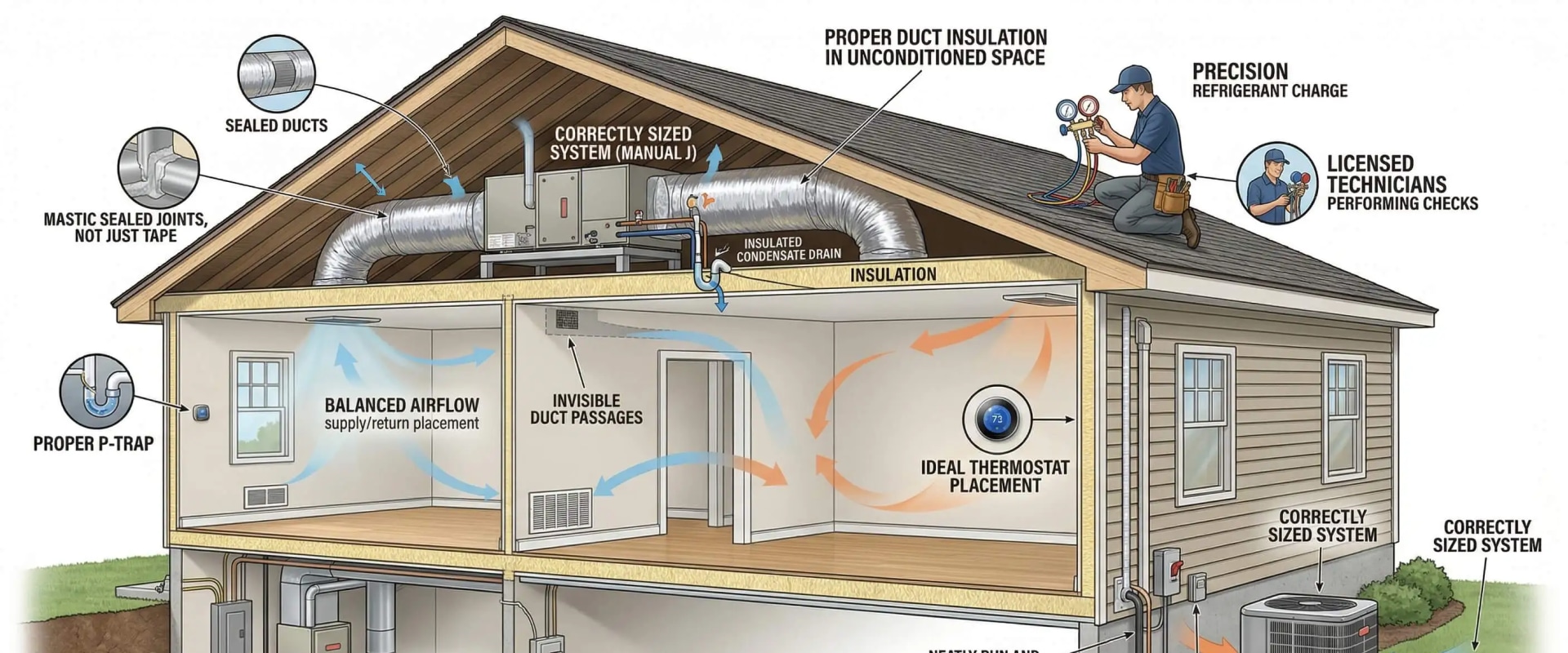
The cooling season around here runs from March through November. Sometimes longer. That stretch of continuous demand exposes every installation shortcut: every duct connection that wasn't properly sealed, every system sized by guesswork instead of calculation. Those gaps show up on your utility bill month after month, and nothing in your house points you back to the day the installer left.
When you're searching for HVAC system installation the questions worth asking aren't about brand names. They're about process. This page covers what makes top HVAC system installation near Winter Park FL worth the investment, how a properly installed system supports long-term comfort and efficiency, and how to recognize quality workmanship with confidence before you sign with anyone.
TL;DR Quick Answers
Top HVAC System Installation Near Winter Park FL
The top HVAC installation in Winter Park comes down to process, not brand name. Here is what separates a quality HVAC installation from one that costs you money every month:
A Manual J load calculation determines the correct system size for your specific home before any equipment is ordered
Proper refrigerant charge verification and airflow measurement happen before the technician leaves
All duct connections are sealed, not just connected
A permit is pulled through Orange County's building department for every job
A commissioning check confirms the system performs as rated before the job closes
Filterbuy HVAC Solutions serves Winter Park and the surrounding Central Florida area. We size equipment to your home, pull required permits, and verify performance before we're done.
Top Takeaways
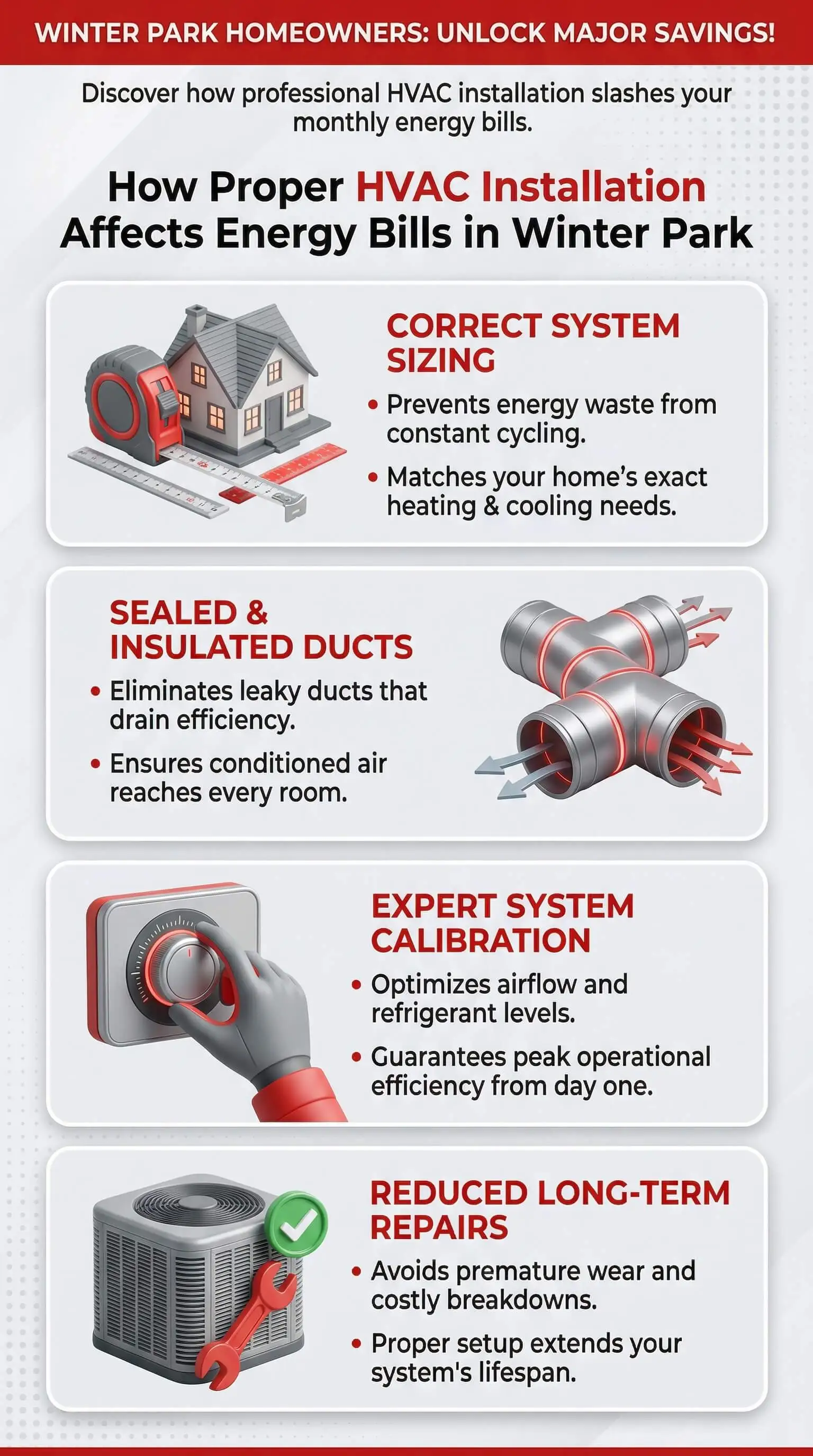
Installation quality determines real-world energy performance more than equipment brand. A poorly installed premium system will consistently underperform a correctly installed mid-grade one.
Manual J load calculations are the foundation of a correct installation. Any contractor who sizes a system without one is guessing, and that guess costs you money every month.
Duct integrity is where installation losses compound fastest. Leaky or unbalanced duct systems can waste 20 to 30 percent of conditioned air before it reaches living spaces.
Winter Park's year-round humidity makes dehumidification performance as important as temperature control. Oversized equipment short-cycles and fails to manage moisture effectively, no matter how high-efficiency the nameplate ratings are.
Refrigerant charge verification at installation is not optional. Incorrect charge reduces efficiency, increases operating costs, and can cause compressor damage over time.
Permits are not a formality. Permitted installations protect your warranty, your insurance coverage, and your ability to sell your home without complications.
Commissioning before the technician leaves is the final checkpoint between a quality installation and one that looks correct on paper but underperforms in practice.
What "Proper" HVAC Installation Actually Means
Installation day isn't the starting point for a quality job. The decisions that matter most get made before the truck pulls up.
A correct installationhvac starts with a Manual J load calculation, a formal engineering process that determines exactly how much heating and cooling capacity your specific home needs. Square footage, insulation levels, window orientation, ceiling height, and local climate data all feed that calculation. Skip it, and the installer is sizing your system by guesswork.
After that comes refrigerant charge verification, airflow measurement across the indoor coil, duct connection sealing, thermostat calibration, and a commissioning check before the technician leaves. Each step has a direct, measurable effect on how efficiently your system runs and how long it lasts. A contractor who skips any of them isn't cutting a corner on paperwork. They're cutting a corner on your energy bill.
The Hidden Ways a Bad Installation Raises Your Energy Bills
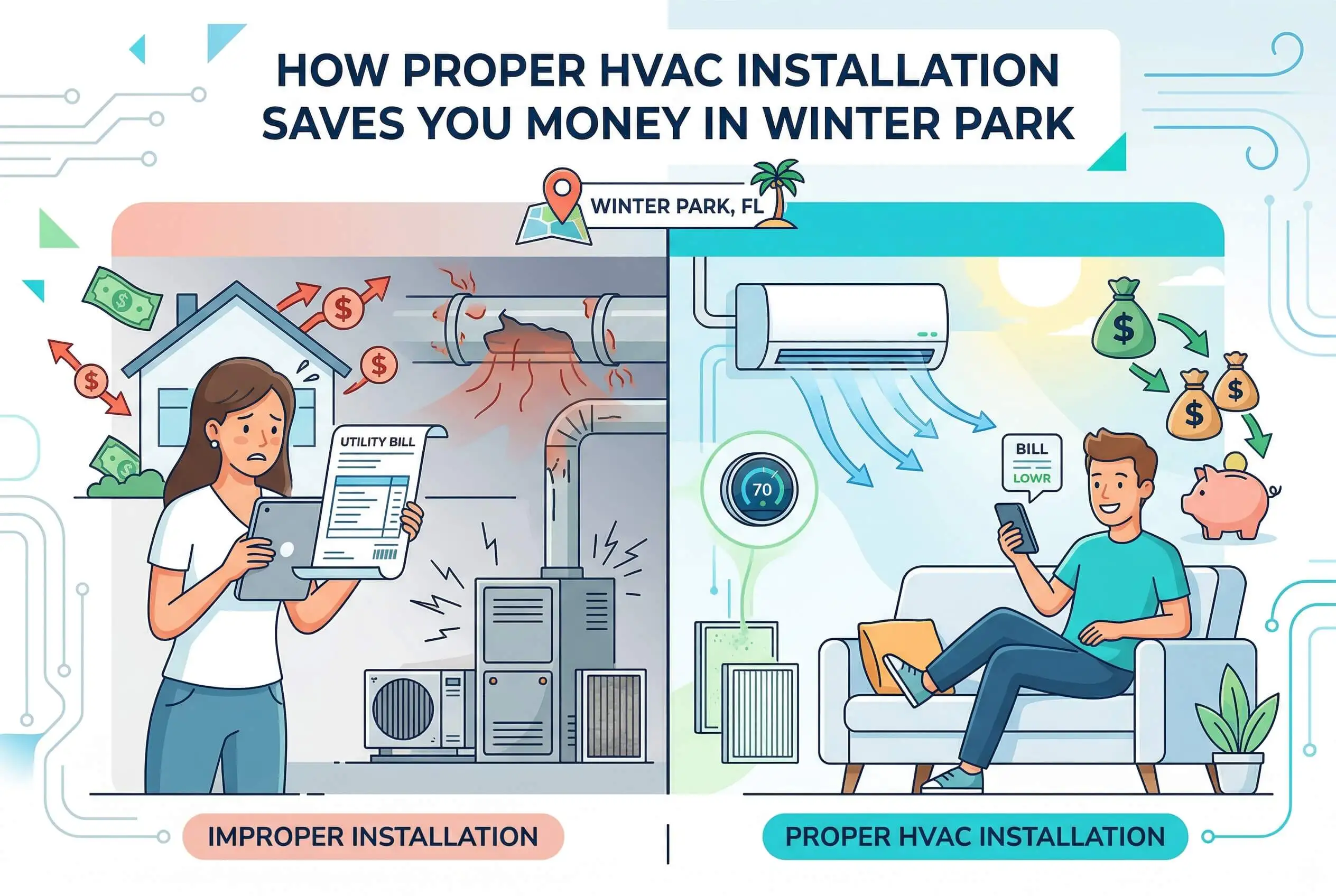
Energy loss from a poor installation rarely announces itself. It shows up month after month on your utility bill, a bit higher than it should be, for a system that looks like it should be running fine.
Oversized equipment is one of the most consistent problems we find in Central Florida homes. When a system is too large for the space it serves, it cools the house quickly and shuts off before completing a full dehumidification cycle. In a climate as humid as ours, that means your home hits the target temperature on the thermostat but still feels thick and uncomfortable. The system short-cycles, starts and stops repeatedly, and wears out components far faster than a correctly sized unit would.
Undersized equipment creates the opposite situation. A system too small for the home runs continuously during peak demand, driving up energy consumption while never quite hitting the set temperature on the hottest days of a Florida summer.
Ducts are where losses compound fastest. Poorly sealed connections let conditioned air leak into unconditioned spaces like attics and wall cavities. That air never reaches the rooms it was meant to cool. You pay to condition it, and it disappears into the walls. Unbalanced airflow from poor duct design leaves some rooms comfortable while others stay warm and stuffy, which pushes homeowners to drop the thermostat to compensate and drives costs up further.
Refrigerant charge is the quietest problem of all. Too little refrigerant reduces cooling capacity and forces the system to work harder for the same result. Too much can damage the compressor over time. Neither condition shows up on a thermostat or triggers an error code.
How Winter Park's Climate Changes the Installation Equation
Winter Park homes aren't all the same. Bungalows built in the 1940s sit a few miles from newer construction in the Golden Triangle area. Each carries a different set of duct challenges, different insulation profiles, and a different relationship with Central Florida's humidity and heat.
The climate here presents challenges that not every contractor comes prepared for. Central Florida sees temperatures above 90 degrees on roughly 100 days a year, and relative humidity regularly exceeds 70 percent through the summer months. A correctly installed system has to manage moisture as aggressively as it manages temperature. Equipment that handles a drier climate well may not deliver the same comfort or efficiency in Orange County.
Heat pump systems fit Winter Park's usage profile well. The mild winters here make the efficiency advantages of a heat pump favorable across both ends of the calendar. Those advantages only show up when the installation is calibrated correctly, though. Refrigerant charge, airflow calibration, and duct integrity aren't optional steps. They're what determines whether the efficiency numbers on the spec sheet ever appear on your actual utility bill.
Older Winter Park homes often carry undersized return ductwork, a holdover from original construction that was never designed to support modern high-efficiency equipment. When a newer, higher-SEER system gets dropped onto that legacy duct infrastructure without an assessment first, the nameplate efficiency rating becomes aspirational. You paid for SEER 18. You get whatever the duct system allows.
What to Look For When Choosing an HVAC Installer Near Winter Park
Start with the permit question. Every HVAC contractor working in Florida needs a valid state certification and must pull the appropriate permits for your installation. A contractor who suggests skipping the permit to save time has already told you something important about how they work.
Ask specifically how they determine system size. A contractor who names a capacity without first completing a Manual J load calculation is skipping the foundational step of the whole process. The right answer takes a few minutes to explain. An evasive one takes about three seconds.
Get the full scope in writing before work begins. Equipment model numbers, SEER ratings, warranty terms, commissioning procedures. A contractor who does the job right has no reason to leave any of it out of a written agreement.
Manufacturer certifications indicate the contractor has been trained on the specific brands they install. That training reduces installation errors and, in many cases, strengthens the warranty terms available to you.
Before the technician closes out the job, ask whether they’ll verify refrigerant charge and measure airflow—because that final commissioning step is part of the Best HVAC installation service and helps ensure your system performs at its full rated comfort, efficiency, and long-term value.
"In the homes we install across Winter Park and Central Florida, the energy losses we trace back most often are not equipment failures. They are installation decisions. A duct connection that was not properly sealed, a refrigerant charge that was never verified, a return system that was not sized for the equipment we hung. Those are the things that show up on your utility bill every month for years, and most homeowners never connect the two."
Essential Resources
Everything You Need to Know Before Scheduling an HVAC Installation in Winter Park
Our Winter Park HVAC installation service page walks through what the process looks like from first contact through final commissioning, including how we size equipment, what permits we pull, and what our technicians check before closing out the job.
The Complete Overview of How Heating, Ventilation, and Air Conditioning Systems Work
This Wikipedia reference gives homeowners a solid grounding in how HVAC systems work before they start comparing contractors or evaluating equipment options.
Source: https://en.wikipedia.org/wiki/Heating,_ventilation,_and_air_conditioning
How to Choose Energy-Efficient Home Cooling Equipment from the U.S. Department of Energy
The Department of Energy's home cooling systems guide breaks down efficiency ratings, equipment types, and what to ask contractors when selecting and installing a new central cooling system.
Source: https://www.energy.gov/energysaver/home-cooling-systems
Why Heat Pumps Are the Right Fit for Central Florida Homes: A DOE Breakdown
The Department of Energy's heat pump resource covers how these systems work, why they perform well in mild-winter climates like Winter Park, and which installation quality factors most directly affect their real-world efficiency.
Source: https://www.energy.gov/energysaver/heat-pump-systems
What Leaky Ducts Are Costing You Every Month: ENERGY STAR's Duct Sealing Guide
ENERGY STAR's duct sealing resource explains how conditioned air escapes through poorly connected ductwork, why that drives up utility bills regardless of equipment efficiency, and what proper sealing involves during and after installation.
Source: https://www.energystar.gov/saveathome/heating-cooling/duct-sealing
How Duct Design and Sealing Quality Affect Long-Term Energy Performance: DOE Technical Guide
This Department of Energy guide details the energy losses associated with leaking and poorly insulated ductwork, and explains why duct system design is a foundational part of any new HVAC installation.
Source: https://www.energy.gov/energysaver/minimizing-energy-losses-ducts
Understanding Home Heating Systems: Efficiency Ratings, Equipment Types, and Maintenance Basics
The Department of Energy's home heating systems guide helps homeowners understand efficiency ratings like AFUE and SEER, what to look for when replacing a system, and how proper maintenance protects energy performance over time.
Source: https://www.energy.gov/energysaver/home-heating-systems
Supporting Statistics
Up to 20% efficiency loss from leaky ducts alone. Leaky duct systems can reduce a home's heating and cooling efficiency by as much as 20 percent, according to ENERGY STAR. In the homes we service across Winter Park and Central Florida, duct leakage from improperly sealed connections at installation is one of the most consistent contributors to elevated monthly utility bills. The equipment may carry a high-efficiency rating. What actually reaches the living space often tells a different story.
Source: https://www.energystar.gov/saveathome/heating-cooling/duct-sealing/benefits
20 to 30 percent of air moving through a typical duct system is lost to leaks. In a typical house, about 20 to 30 percent of the air moving through the duct system is lost due to leaks, holes, and poorly connected ducts, according to ENERGY STAR. For a Winter Park homeowner, that translates directly: if your system is pushing 1,000 cubic feet per minute of conditioned air, somewhere between 200 and 300 cubic feet of it goes into your attic or wall cavities instead of your living room. You're paying to condition air that never cools anyone in your house.
Source: https://www.energystar.gov/saveathome/heating-cooling/duct-sealing
Heating and cooling represent approximately 48 percent of the average home utility bill. Home heating and cooling account for about 48 percent of the average utility bill, according to the U.S. Department of Energy. In a climate like Winter Park's, where cooling demand runs nearly year-round, your HVAC system's share of your energy costs likely runs higher than that national figure. That proportion is why installation quality is a financial decision as much as a comfort one. A system running five to ten percent below its rated efficiency compounds into hundreds of dollars over a single year.
Source: https://www.energy.gov/articles/askenergysaver-home-heating
Final Thoughts and Opinion
After working on HVAC systems across Winter Park and Central Florida, the pattern we keep running into isn't equipment that failed. It's installation quality that caught up with homeowners slowly: a bill that climbed instead of dropped after a new system went in, rooms that never quite settled, compressors wearing out years ahead of schedule.
Most of the decisions that determine what you actually pay every month get made before the equipment arrives. The load calculation, the duct design, the refrigerant charge, the commissioning process. The brand name on the unit is a supporting detail.
The demand in Winter Park is relentless enough that a marginal installation becomes a persistent, expensive one. Every installation flaw compounds across a ten-month cooling season. Getting it right the first time protects both your comfort and the long-term value of a significant investment in your home.
Here is our position on what a good contractor looks like: one who walks you through their sizing methodology before quoting, puts the full scope in writing before starting, pulls every required permit, and checks back in after the first summer to ask how the system performed. Those contractors exist. They are worth finding.
That is the standard we hold ourselves to. It is the standard every homeowner in Winter Park deserves.
Frequently Asked Questions
Q: How much does HVAC installation cost in Winter Park, FL?
A:
HVAC installation in Winter Park typically runs between $4,500 and $12,500 or more, depending on system type, size, and how much ductwork the job involves.
Heat pump systems tend to cost more upfront than traditional split systems but deliver greater long-term efficiency savings in Central Florida's climate.
Quotes that come in well below that range may reflect shortcuts in sizing, permitting, or commissioning. Low price and incomplete scope often go together.
The most useful comparison between quotes isn't price. Its scope. Ask what the load calculation process involves and whether commissioning is included before you evaluate any number.
Q: How long does HVAC installation take in a typical Winter Park home?
A:
Most residential HVAC installations wrap up in one day for a straightforward system swap.
Jobs involving new ductwork, attic air handler placement, or significant modifications to the return system can run two to three days.
Permit scheduling adds lead time in Orange County. A contractor who plans properly will build this into the timeline upfront rather than calling you the morning of the job.
Q: Do I need a permit for HVAC installation in Winter Park?
A:
Yes. HVAC installation in Winter Park requires a permit through Orange County's building department.
Permits ensure a licensed inspector reviews the work and verifies it meets Florida Building Code requirements.
Skipping the permit creates liability if an insurance claim involves the system, and can surface as a problem during a buyer's inspection when you sell.
Filterbuy HVAC Solutions pulls all required permits as a standard part of every installation.
Q: What SEER rating should I choose for a Winter Park HVAC system?
A:
Florida's year-round cooling demand makes a higher SEER rating a sound investment. Systems rated SEER 16 or above match Winter Park's usage profile well.
ENERGY STAR-certified systems, which require SEER 15 or higher for central air conditioners, offer a reliable efficiency benchmark.
SEER ratings reflect laboratory test conditions. Real-world performance depends heavily on installation quality. A SEER 20 system on a poorly sealed duct network will not deliver SEER 20 performance in your home.
Q: Is a heat pump a good choice for a home in Winter Park?
A:
Yes. Winter Park's mild winters make heat pump systems a strong fit for the local climate. Heat pumps deliver efficient cooling in summer and cost-effective heating through the mild temperatures Central Florida sees from November through February.
Modern heat pump systems with SEER2 ratings of 16 or higher perform well in Florida's warm-humid climate zone.
Proper installation, including verified refrigerant charge and airflow calibration, is especially important for heat pumps to deliver on their rated efficiency.
Q: What are the signs of a bad HVAC installation?
A:
Energy bills that rise after a new system goes in rather than falling.
Rooms that stay uncomfortable even when the system runs continuously.
Excessive humidity indoors even after the thermostat's target temperature is reached.
Short-cycling patterns where the system starts and stops frequently in brief intervals.
No permit on record with Orange County for the installation work.
A technician who closed out the job without running a commissioning verification or leaving documentation.
Q: How do I compare HVAC installation quotes in Winter Park?
A:
Compare the full scope of work, not just the bottom-line number. Two quotes at similar prices can represent very different levels of service.
Confirm that each quote includes a load calculation, permit filing, commissioning, and warranty documentation.
Ask each contractor what system brand and SEER rating they're recommending and why that equipment fits your specific home.
Verify licensing status through the Florida Department of Business and Professional Regulation before signing anything.
Your Winter Park Home Deserves an Installation Done Right
We've worked with homeowners across Winter Park and Central Florida long enough to know that the HVAC decisions people regret almost never come down to equipment choice. They come from rushing the installation, or choosing a contractor who did the same.
Getting it right is a process. Schedule a free estimate and we'll walk through your home, run a proper load calculation, and give you a clear picture of what your installation should include before you commit to anything.
Schedule your free HVAC installation estimate and see what a properly installed system can do for your home and your energy bills.
In “How Proper HVAC Installation Affects Energy Bills in Winter Park,” it makes sense to show that efficiency is not determined by installation alone, because long-term energy performance also depends on maintaining the system with the right replacement filter. Product examples such as 16x20x1 MERV 8 pleated air filter, 20x25x4 MERV 8 pleated HVAC air filter, and 13x21.5x1 pleated air filter fit naturally into the topic because they reinforce a practical point for Winter Park homeowners: even a properly installed HVAC system can see higher operating costs when filter choice and replacement are neglected, while correctly sized filters help support steady airflow, cleaner indoor air, and more efficient day-to-day performance.