
TL;DR Quick Answers
Air Filters
Air filters are the cheapest performance upgrade in any HVAC system. They protect indoor air, reduce equipment wear, and lower energy bills when they're sized and replaced on schedule. In our experience, three things have to be right:
Size: measured directly from the rack, not guessed from the last one
MERV: matched to the blower's static pressure tolerance (usually 8–13)
Cadence: swap every 30–90 days depending on system type and household
Top Takeaways
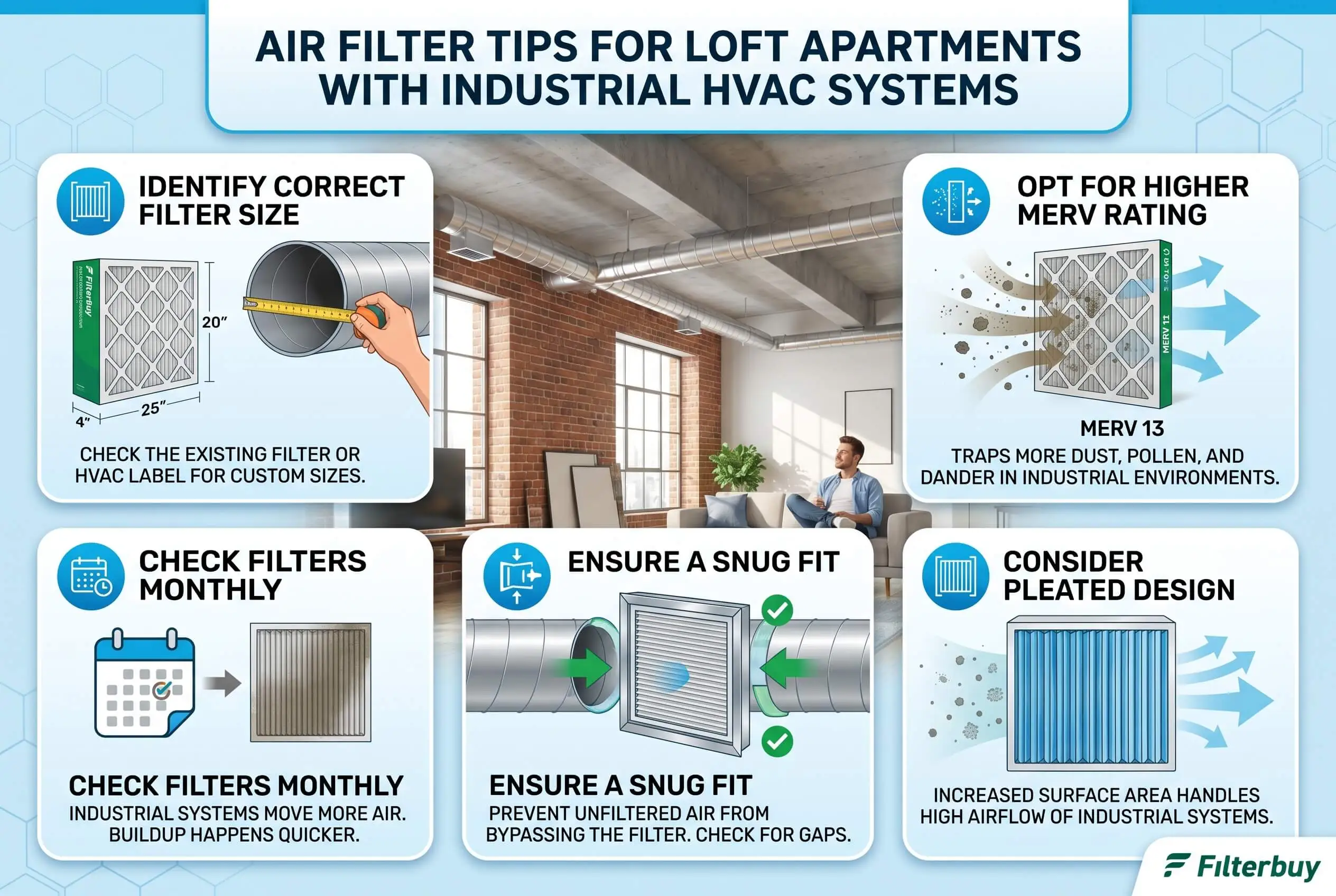
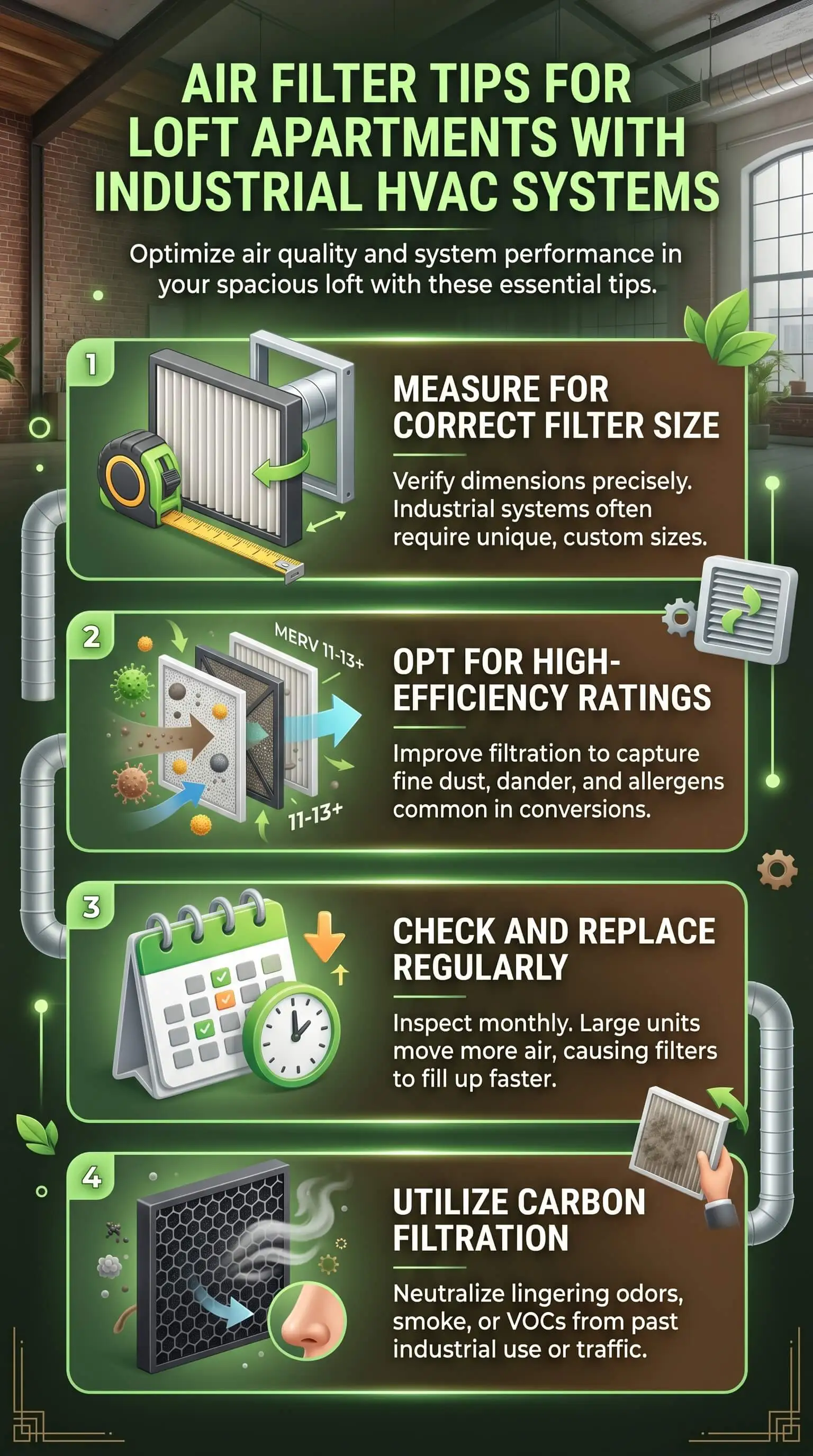
The rack sets the filter size. Measure it in three dimensions before ordering.
Industrial HVAC moves more air than residential equipment, so filters load up faster. Plan on swapping every 30 to 60 days in most lofts.
MERV selection depends on the system's static pressure tolerance. Most loft systems handle MERV 8 to 13 without trouble.
Open floor plans pull dust off exposed beams and brick at a higher rate. Match the change cadence to the load, and the space stays clean.
Why Loft Apartment Filtration Is Different
Industrial Equipment in a Residential Setting
Most loft conversions keep the original HVAC equipment in place after the residential build-out. That usually means a rooftop packaged unit. One box on the roof handles both heating and cooling, with ductwork that runs along the exposed ceiling beams. There's no basement furnace, no outdoor condenser sitting next to a hedge.
Filter access varies by building. The most common spots are a high-ceiling return grille, a side-mounted rack tucked into an interior wall, or a roof-level access hatch that building maintenance handles directly. The arrangement determines what you buy, when you check it, and whether the swap is yours to make or a work-order request.
What Open Floor Plans Do to Filtration Load
One big open room makes filtration work harder than a maze of walled rooms ever could. A single return grille pulling air across 2,000 square feet has no interior walls to slow the path, so air velocity stays high over every exposed surface — beams, brick, ductwork, the spine of every book on the shelf. Settled dust never gets a chance to actually settle.
Particulate matter is what a particulate air filter is built to catch: dust, pollen, smoke, urban soot drifting in through tall operable windows, and the fibers from rugs and upholstery that any apartment produces. In a loft, that load reaches the filter faster than it would in a one-bedroom across the hall, so the filter loads up faster and the change interval shortens with it.
Getting the Filter Size Right
Filter sizing for an industrial system starts at the rack, and the rack accepts what it was built to accept. That's almost never a one-inch panel from the front aisle of the hardware store. The sizes we see most often in loft conversions are 20x25x4, 16x25x4, 20x25x5, 24x24x2, and 20x20x2 — deeper and usually wider than the residential standard, because the blower behind them moves a lot more air.
When the rack doesn't match any size on the shelf, custom-sized air filters are the practical answer. Pre-2010 commercial buildings especially tend to carry over non-standard rack dimensions from whatever equipment was originally specified. Pull a tape measure before you order anything and write down length, width, and depth to the nearest eighth of an inch. The rack will tell you what fits.
Choosing the Right MERV Rating
MERV is the scale the EPA uses to rate how well a filter catches particles between 0.3 and 10 microns. Higher number, smaller particle. For most loft systems running industrial HVAC, the practical working range sits between MERV 8 and MERV 13.
The blower is what decides where you land in that range. An industrial unit was built for higher static pressure than a residential furnace, so it has more headroom to push air through denser filter media without losing airflow elsewhere. That headroom is the reason loft dwellers can usually run MERV 11 or 13 when allergies, urban air quality, or asthma make the upgrade worth it. Building maintenance can pull the rated static pressure tolerance for you. When in doubt, MERV 11 filter is the middle ground we recommend for most converted commercial systems.
Replacement Cadence
More air moving through a single filter means faster loading. A residential one-inch panel might stretch to 90 days. An industrial loft system usually needs a fresh filter every 30 to 60. Pets shorten the interval. So does a window facing a busy urban corridor, or a hot summer that has the cooling running hard. Pull the filter monthly for the first six months in a new loft and you'll learn the cadence your space actually demands. The filter itself tells the truth. Hold it up to the light and you'll see when it's done.
"Two things catch new loft tenants every time," says. "They buy a one-inch panel because that's what they bought in their last apartment, and the rack actually needs a four- or five-inch pleated. Then they wait 90 days the way they used to, and the filter's been gray for six weeks. Once they get both right, the system runs better and they actually remember when to swap it."
Essential Resources
EPA, Indoor Air Quality (IAQ). Federal hub covering filtration, ventilation, source control, and building-type guidance in one place.
EPA, What is a MERV Rating?. The reference table for the MERV 1–16 scale and the particle-size ranges each level catches.
EPA, The Inside Story: A Guide to Indoor Air Quality. The foundational EPA document on indoor pollutants, exposure pathways, and what increases risk inside a home or apartment.
EPA, What is a HEPA Filter?. Clear answer on the difference between HEPA and high-MERV filtration, and what HEPA actually delivers in practice.
EPA, Should You Use an Air Cleaner?. EPA guidance on when a portable air cleaner adds value beyond what HVAC filtration already does.
CPSC, Inside Story Guide to Indoor Air Quality. The Consumer Product Safety Commission companion to the EPA Inside Story, drawing from the same federal source material.
Wikipedia, Air Filter. General-audience reference for filter mechanics, particulate capture principles, and the history of HVAC filtration.
Supporting Statistics
Americans spend approximately 90 percent of their time indoors. That figure comes from the EPA's report on indoor air quality and remains the standard cited baseline for indoor exposure research. Source: EPA Report on the Environment, Indoor Air Quality.
Indoor pollutant concentrations are often 2 to 5 times higher than typical outdoor concentrations. EPA exposure studies put that range at the typical case, with peaks above 100 times outdoor levels during specific indoor activities. Source: EPA Report on the Environment, Indoor Air Quality.
HEPA filters remove at least 99.97 percent of airborne particles 0.3 microns and larger. The 0.3-micron threshold is the most-penetrating particle size, which is why HEPA gets defined against it rather than an easier target. Source: EPA, What is a MERV Rating?.
Final Thoughts and Opinion
Loft filtration is two decisions. Know your rack so the filter actually fits, and pull the filter often enough in the first six months to learn the cadence your space demands. After years of supplying top air filters into converted commercial buildings, our honest take is that loft tenants can get much better performance by choosing the right MERV rating and confirming the right size instead of guessing. Industrial HVAC often has more headroom than people realize, which gives top air filters a real opportunity to improve comfort, capture more dust, and support cleaner daily airflow. The cost of getting it right is a few minutes a month.
Frequently Asked Questions
What size air filter does a loft apartment use?
Loft apartments running industrial HVAC typically use deeper filters than standard residential sizes. The most common are 20x25x4, 16x25x4, 20x25x5, and 24x24x2. Measure the existing rack in three dimensions before ordering. Pre-2010 conversions often have non-standard openings that need a custom size.
Can I use a higher MERV filter in an industrial HVAC system?
Usually yes, and HVAC maintenance is what makes that upgrade safer and more effective. Industrial blowers are built for higher static pressure than residential furnaces, which gives them headroom to push air through denser filter media. MERV 11 is a reliable middle ground for most converted commercial systems, especially when regular HVAC maintenance keeps airflow, filter fit, and blower performance in check. Confirm the rated static pressure tolerance with building maintenance before moving to MERV 13.
How often should a loft apartment air filter be changed?
Most loft apartments running industrial HVAC need a fresh filter every 30 to 60 days. Buildings along busy urban corridors, lofts with pets, or systems running heavy cooling loads sit at the shorter end of that range. Pull the filter monthly for the first six months in a new loft to learn the cadence your space requires.
Why does my loft apartment collect dust faster than a regular apartment?
Open floor plans give air a longer uninterrupted path, so settled dust stays in circulation longer. The filter also collects particulate from exposed brick, beams, and ductwork at a higher rate than walled residential layouts produce. The dust load is normal for the space type. It's just heavier than a closed-room apartment.
Find Air Filters Built for Your Loft
Loft systems were built for industrial workloads, and a properly sized filter is the lowest-effort performance upgrade you have. Measure your rack, decide your MERV, and order from a supplier that stocks both standard sizes and custom dimensions. That's the whole job.