
That qualification matters more here than almost anywhere else. Altamonte Springs homes run sealed ten to eleven months per year. There's no open-window season to dilute what builds up indoors. No natural air exchange to reset the indoor environment. What the HVAC system doesn't address stays in the home — and recirculates through it.
The EPA documents that indoor air can be two to five times more polluted than outdoor air. In Central Florida's sealed-home climate, that's not a national average. It's a local baseline.
Here's what years of working in this community have taught us:
A new system can dramatically improve indoor air quality. But we've assessed Altamonte Springs homes with relatively recent equipment and persistent air quality problems. The system was new. The installation was wrong.
What we found in those homes:
Oversized equipment short-cycling — never completing a dehumidification cycle
Duct systems leaking unconditioned attic air directly into living spaces
Humidity levels in the low sixties despite a system running continuously
Recurring mold in the same locations it appeared before the replacement
The system was replaced. The conditions weren't. That's the distinction this page is built around.
What you'll find here:
Why Central Florida's climate makes indoor air quality uniquely dependent on HVAC performance
The specific ways a correctly installed system improves what your family breathes every day
Why system size determines air quality outcomes as much as equipment quality
What a replacement that actually improves indoor air quality looks like — versus one that just swaps aging equipment
What Altamonte Springs homeowners consistently report after a correctly sized, properly installed replacement
A new HVAC system will improve your home's air quality with top HVAC system replacement near Altamonte Springs FL. This page explains exactly what has to be true for that answer to hold.
TL;DR Quick Answers
Will a New HVAC System Improve Indoor Air Quality in My Altamonte Springs FL Home?
Yes — but only if four things are true about the installation. Equipment alone is not enough.
The four variables that determine whether air quality actually improves:
Correct sizing — Manual J load calculation performed. Humidity held below CDC-recommended 50 percent from day one. Oversized systems short-cycle and never complete dehumidification — regardless of efficiency rating.
Duct integrity — Duct system assessed and sealed before new equipment is installed. Homes lose 25 to 40 percent of conditioned air through leaks. In Central Florida attics exceeding 130 degrees — consistently at the higher end. New equipment on leaking ducts delivers a fraction of rated air quality performance.
Appropriate filtration — MERV 13 for most Altamonte Springs homes. Captures bacteria, mold spores, and respiratory droplets at clinically meaningful rates. Must be confirmed compatible with system airflow at installation — not selected after.
Ventilation adequacy — Installation meets ASHRAE 62.2 ventilation standards. Only mechanism providing fresh air exchange in a sealed Central Florida home running year-round.
What the research confirms:
EPA: Indoor air is two to five times more polluted than outdoor air — sealed Altamonte Springs homes have no natural reset
CDC: Indoor humidity must stay below 50 percent to prevent mold and biological pollutant growth
DOE: Duct systems lose 25 to 40 percent of conditioned air — in Central Florida attics, consistently at the higher end
What homeowners in this community report after a correctly installed replacement:
House smells cleaner from day one — less musty, less heavy
Indoor humidity stabilizes below 50 percent within the first week
Allergy and respiratory symptoms reduce within the first 30 days
Mold that returned repeatedly to the same locations stops returning
Duke Energy bills drop and stay down — system runs steadier, shorter, more efficiently
What doesn't improve air quality despite new equipment:
Oversized systems short-cycling — never completing dehumidification cycles
New equipment installed on leaking, unassessed duct systems
MERV 13 filters on systems not sized to accommodate airflow resistance
Installations that replaced equipment without addressing ventilation adequacy
The bottom line: two Altamonte Springs homes with identical high-efficiency systems can have dramatically different air quality outcomes six months after installation — based entirely on whether sizing, duct condition, filtration, and ventilation were addressed correctly. The equipment is the last conversation. The installation process is the first. When that sequence is right — the improvement is real, measurable, and immediate from the first day of operation.
Top Takeaways
A new HVAC system will improve indoor air quality — but only if the installation addresses more than the equipment.
EPA documents indoor air is two to five times more polluted than outdoor air
Altamonte Springs homes run sealed 10 to 11 months per year — no natural dilution, no reset
The HVAC system is the only mechanism for addressing what accumulates indoors
What we find in homes with recent equipment and persistent air quality problems:
System was new — installation was wrong
Oversized equipment short-cycling — never completing filtration or dehumidification cycles
Duct systems leaking unconditioned attic air into living spaces
Humidity in the low sixties despite a system running continuously
Equipment replacement without correct sizing, duct assessment, and proper filtration doesn't improve the indoor environment. It recirculates the same conditions more efficiently.
Correct sizing is the variable that determines whether indoor air quality improvement is real or theoretical.
CDC recommends holding indoor humidity below 50 percent to prevent mold and biological pollutant growth
Oversized systems that short-cycle consistently fail to reach that threshold
Typical humidity readings in Altamonte Springs homes with improperly sized systems: low to mid sixties
That's 10 to 15 percentage points above the CDC biological threshold — regardless of how recently the system was installed
What correct sizing through Manual J delivers:
Full dehumidification cycles that extract moisture before the system shuts off
Humidity held consistently below the CDC-recommended 50 percent threshold
Elimination of the short-cycling pattern that leaves moisture conditions unresolved
An indoor environment where biological conditions for mold growth are removed — not just treated
Duct condition explains more persistent air quality problems than any other single factor we assess.
DOE documents duct systems lose 25 to 40 percent of conditioned air through leaks
In Central Florida attics exceeding 130 degrees — consistently at the higher end of that range
Every percentage point of loss introduces unconditioned, unfiltered attic air into living spaces
What duct leakage does to a new system's air quality performance:
Bypasses filtration entirely — unfiltered air enters conditioned spaces
Elevates humidity regardless of how correctly the equipment is sized
Creates pressure imbalances pulling contaminants from wall cavities into living areas
Reduces a new high-efficiency system to a fraction of its rated air quality performance
Duct assessment isn't an upgrade conversation. It's a prerequisite.
MERV 13 is the filtration threshold that matches the air quality responsibility an Altamonte Springs HVAC system carries — but only when sized to accommodate it.
ASHRAE documents MERV 13 captures fine biological particles at clinically meaningful rates
Bacteria, mold spores, and respiratory droplets — captured at MERV 13, not at MERV 8
In a sealed Central Florida home with no natural air dilution — MERV 13 is not a premium upgrade
What filtration selection requires:
Higher MERV ratings increase airflow resistance
A system not designed for MERV 13 works against the filter — not with it
Filtration selection must be part of the sizing conversation — not an afterthought after installation
Filter replacement in Central Florida: every 60 to 90 days — not the 90 to 180 days manufacturers suggest for average conditions
The indoor air quality improvement a new system delivers is determined by the installation process — not the equipment alone.
The four variables that determine whether air quality improvement materializes:
Correct sizing — Manual J performed, humidity held below CDC threshold from day one
Duct condition — assessed, sealed, and delivering conditioned air without attic contamination
Filtration selection — MERV 13 confirmed compatible with system airflow at installation
Ventilation adequacy — fresh air exchange meeting ASHRAE 62.2 for the home's configuration
What the homes with the best outcomes share:
All four variables addressed before installation was complete
Duct assessment included — not added as an afterthought
Filtration selected as part of sizing — not after equipment was installed
What the homes with persistent problems share:
At least one of the four variables missed
Usually the duct assessment
Sometimes the sizing
Occasionally all four
The equipment is the last conversation — not the first. When that sequence is reversed, the air quality improvement the homeowner paid for doesn't fully materialize.
The indoor air quality challenge in Central Florida isn't complicated. It's a sealed building envelope combined with year-round humidity and a system that runs continuously with no natural dilution from outside air.
Most U.S. homes get a natural reset several months per year — windows open, outdoor air circulates, indoor pollutant concentrations drop. Altamonte Springs homes don't get that reset. What accumulates indoors stays indoors. Dust, biological particles, VOCs from building materials and household products, moisture-driven mold spores — all of it recirculates through the same duct system, through the same filter, through the same living spaces.
What the EPA's research documents about this environment:
Indoor air is two to five times more polluted than outdoor air in typical U.S. homes
In homes with elevated moisture conditions, biological pollutant concentrations increase significantly
Inadequate ventilation is among the primary drivers of poor indoor air quality in residential settings
The HVAC system is the primary — and in a sealed Central Florida home, often the only — mechanism for addressing all of it
This is why the HVAC system in an Altamonte Springs home carries more responsibility for indoor air quality than the same system in almost any other U.S. climate. And it's why installation quality, system sizing, and duct condition determine air quality outcomes in ways that equipment brand and efficiency rating alone never will.
How a Correctly Sized System Changes the Indoor Environment
System sizing is the variable most air quality conversations skip — and the one that matters most in this climate.
An oversized system in an Altamonte Springs home reaches the thermostat's target temperature quickly and shuts off. The run cycle is short. The dehumidification cycle is incomplete. Moisture stays in the air. Humidity levels remain in the low sixties — well above the CDC-recommended threshold of 50 percent — despite the system running regularly.
That humidity level is the condition mold requires. Not the mold itself. The condition.
What correct sizing delivers that oversizing never can:
Full dehumidification cycles that extract moisture from living spaces before the system shuts off
Humidity held consistently below the CDC-recommended 50 percent threshold
Elimination of the short-cycling pattern that leaves moisture conditions unresolved
An indoor environment where the biological conditions for mold growth are removed — not just treated
We've assessed homes in this community where mold remediation had been performed two and three times. The remediation addressed the visible mold. Nobody addressed the humidity conditions that made the mold possible. In almost every case, the HVAC system was oversized. In almost every case, correct sizing was the intervention that broke the cycle.
A correctly sized system doesn't just cool the home more efficiently. In Central Florida's climate, it fundamentally changes the indoor environment.
What Duct Condition Has to Do With the Air Your Family Breathes
The duct system is the delivery mechanism for everything the HVAC system produces — conditioned air, filtered air, dehumidified air. It's also, in most Altamonte Springs homes we assess, one of the primary sources of indoor air quality problems.
The DOE documents that duct systems in typical U.S. homes lose 25 to 40 percent of conditioned air through leaks, disconnected sections, and inadequate insulation. In Central Florida homes, where ducts run through unconditioned attic space regularly exceeding 130 degrees, those losses consistently reach the higher end of that range.
What duct leakage introduces into the living environment:
Unconditioned air from attic spaces carrying heat, humidity, and biological particles
Unfiltered air bypassing the system's filtration entirely
Pressure imbalances that pull contaminants from wall cavities and crawl spaces into conditioned areas
Moisture-laden air that elevates indoor humidity regardless of how efficiently the equipment runs
What this means for a new system installation:
A high-efficiency system installed on a leaking duct network delivers a fraction of its rated air quality performance
The filtration the new system provides is compromised by every unfiltered cubic foot entering through duct leaks
The dehumidification the new system performs is offset by every moisture-laden cubic foot leaking in from the attic
Duct assessment and sealing is not an optional upgrade — it's a prerequisite for air quality improvement
We include duct evaluation in every assessment we conduct in this area. A new system installed without duct assessment is a missed opportunity to actually improve the indoor environment — regardless of how efficient the new equipment is.
The Filtration Upgrade Most New System Installations Miss
A new HVAC system creates a natural opportunity to address filtration — and most installations don't take it.
The filter in an HVAC system is the primary mechanism for removing particulate matter from circulating air. Dust, pollen, pet dander, mold spores, and fine particles all pass through the filter on every air circulation cycle. The MERV rating of the filter determines what gets captured and what gets returned to the living space.
What MERV ratings mean in practical terms for Altamonte Springs homeowners:
MERV 8 — captures larger particles, standard builder-grade filtration
MERV 11 — captures fine particles including pet dander and mold spores
MERV 13 — captures very fine particles including bacteria and smoke — the threshold the CDC recommends for improved respiratory health outcomes
What we recommend for every Altamonte Springs home:
MERV 13 filtration for homes with allergy sufferers, respiratory conditions, or persistent air quality concerns
MERV 11 as the minimum for any home in Central Florida's humidity environment
Filter replacement every 60 to 90 days — not the 90 to 180 days most manufacturers suggest for average conditions
One thing worth understanding about filtration upgrades: higher MERV ratings increase airflow resistance. A system not designed or sized to accommodate higher-MERV filtration will work harder, consume more energy, and wear faster. This is exactly why filtration selection should be part of the system sizing conversation — not an afterthought after installation is complete.
What Altamonte Springs Homeowners Consistently Report After a Correctly Installed Replacement
We ask this question after every replacement we complete: what changed most in how the home feels?
The answers follow a consistent pattern — and almost none of them are about temperature.
What homeowners report most consistently:
The house smells different. Cleaner. Less musty. The background humidity that made every room feel heavy is gone.
Allergy and respiratory symptoms reduced — sometimes significantly — within the first few weeks
The system runs quieter and less frequently — but the home stays more comfortable and drier than before
Mold that had returned repeatedly in the same locations has not returned since the replacement
The air feels lighter in a way that's difficult to describe but immediately noticeable
What almost nobody reports as the primary change: temperature. The old system was getting the home to temperature. That wasn't the problem. The problem was everything the old system wasn't doing while it got there — the moisture it wasn't removing, the particles it wasn't capturing, the attic air it was pulling in through leaking ducts.
That's the insight worth carrying into this decision. A correctly sized, properly installed HVAC system in an Altamonte Springs home doesn't just replace old equipment. It changes the indoor environment itself. The air quality improvement is real, measurable, and with the right HVAC replacement service immediate from the first day of operation.
"In almost every persistent air quality case we investigate in Altamonte Springs, the homeowner has already tried something. A new filter. A dehumidifier. Surface mold remediation — sometimes more than once. What they haven't tried is addressing the system conditions that made the problem possible in the first place. An oversized system that short-cycles never finishes dehumidifying. A duct system leaking attic air into living spaces undermines every filter in the house. A sealed Central Florida home with no natural air dilution amplifies every one of those failures every day the system runs. We've assessed homes where a correctly sized replacement with proper duct sealing resolved air quality problems that three rounds of remediation hadn't touched. The equipment gets the credit. The sizing and the duct work did the actual work. That's the part of this conversation most homeowners never hear until after the third remediation estimate."
Essential Resources
We've had this conversation with a lot of families in this community. The ones who understand the connection between HVAC performance and indoor air quality make better decisions — not just about equipment, but about the entire installation process. These are the seven resources we'd put in front of any neighbor asking whether a new system will actually improve the air their family breathes.
The Resource That Changed How We Think About Every Replacement We Install
U.S. Environmental Protection Agency — Indoor Air Quality
This is the EPA research we reference in every assessment we conduct in Altamonte Springs homes. It reframes what a replacement decision actually means — not a comfort upgrade, but a direct intervention in the air quality environment a family lives in every day.
Indoor air is two to five times more polluted than outdoor air in typical U.S. homes
Sealed Central Florida building envelopes eliminate natural dilution — what accumulates indoors stays indoors
Inadequate ventilation is among the primary drivers of poor indoor air quality
The HVAC system is the primary — and often only — mechanism for addressing all of it in a sealed home
https://www.epa.gov/indoor-air-quality-iaq
Why the Mold Keeps Coming Back — and What the EPA Says About Fixing It for Good
U.S. Environmental Protection Agency — Mold and Moisture
We've walked through Altamonte Springs homes where mold remediation had been performed two and three times. This is the resource that explains why — and why the conversation has to start with moisture conditions, not surface treatment. We share it with every homeowner facing recurring mold before we discuss equipment.
Mold requires moisture — controlling humidity is the only intervention that prevents recurrence
Surface remediation without addressing moisture conditions produces recurring mold
HVAC sizing and dehumidification performance determine whether mold conditions are removed or just treated
Humidity control is an HVAC function — not a remediation function
The CDC Standard We Reference in Every Altamonte Springs Home We Assess
Centers for Disease Control and Prevention — Indoor Environmental Quality
When we tell homeowners their indoor humidity needs to stay below 50 percent, this is the research behind that recommendation. It's the standard we measure against in every home we walk through — and the threshold that determines whether a system is actually protecting the family living in it.
Indoor humidity must be held below 50 percent to prevent mold and biological pollutant growth
Oversized systems that short-cycle consistently fail to achieve this threshold
Respiratory health outcomes are directly connected to indoor biological pollutant concentrations
Correct system sizing is the mechanism that holds humidity below the CDC-recommended threshold
https://www.cdc.gov/niosh/topics/indoorenv/default.html
The Reason We Assess Every Duct System Before Recommending New Equipment
U.S. Department of Energy — Duct Sealing
This is the research we walk homeowners through when they ask why we include duct assessment in every evaluation. In Central Florida attics exceeding 130 degrees, duct leakage isn't a minor efficiency issue — it's a direct pathway for unconditioned, unfiltered air into the living spaces a family breathes every day.
Duct systems lose 25 to 40 percent of conditioned air through leaks in typical U.S. homes
In Central Florida attics, losses consistently reach the higher end of that range
New high-efficiency equipment installed on leaking ducts delivers compromised air quality performance
Duct sealing is not an add-on conversation — it's a prerequisite for the new system to deliver its full benefit
https://www.energy.gov/energysaver/duct-sealing
How to Confirm the Equipment We Recommend Meets Independent Air Quality Standards
U.S. Environmental Protection Agency — ENERGY STAR Indoor Air Package
We recommend ENERGY STAR certified equipment on every qualifying installation because certification means the performance claims are independently verified — not manufacturer self-reported. This resource gives homeowners the ability to confirm that for themselves before equipment is selected.
ENERGY STAR certification indicates independently verified performance — not manufacturer claims
Certified equipment meets filtration, ventilation, and efficiency thresholds connected to measurable air quality improvement
Certification is the threshold that qualifies equipment for federal tax credits and Duke Energy utility rebates
Equipment selection and air quality outcome are connected decisions — this resource helps homeowners understand why
https://www.energystar.gov/index.cfm?fuseaction=find_a_product.showProductGroup&pgw_code=IA
The Industry Standard That Tells You Whether a Contractor's Installation Plan Is Complete
American Society of Heating, Refrigerating and Air-Conditioning Engineers — ASHRAE 62.2
We design every installation around ASHRAE 62.2 ventilation standards — because adequate ventilation is what separates a system that actively improves indoor air quality from one that simply moves conditioned air around. This resource gives homeowners the framework to ask the right questions about ventilation before installation begins.
Defines minimum ventilation rates required for acceptable indoor air quality in residential buildings
A contractor whose installation plan doesn't reference ventilation requirements is leaving air quality performance on the table
Understanding this standard helps homeowners recognize whether a proposal addresses the full scope of air quality improvement
Ventilation adequacy is a standard installation requirement — not a premium conversation
https://www.ashrae.org/technical-resources/bookstore/standards-62-1-62-2
The Florida-Specific Resource Most Altamonte Springs Homeowners Have Never Seen
Florida Department of Health — Indoor Air Quality
National air quality resources are built on average U.S. conditions. This one is built for Florida — addressing the specific indoor air quality challenges of year-round sealed-home living in a high-humidity climate. It's the most locally relevant reference we share with families in this community because it speaks directly to the conditions they're actually living in.
Addresses humidity, mold, and air quality conditions specific to Florida's sealed-home climate
Provides state-level guidance that national resources don't capture for Central Florida homeowners
Documents the indoor air quality challenges unique to year-round air conditioning in a high-humidity environment
The most locally relevant air quality reference available for any family living in Altamonte Springs
https://www.floridahealth.gov/environmental-health/indoor-air-quality/index.html
These essential resources show why professional HVAC system replacement service is what makes air-quality improvement real—because controlling humidity, sealing ducts, meeting ventilation standards, and selecting independently certified equipment are the specific conditions that turn a replacement into cleaner air your family can feel.
Supporting Statistics
We reference research every time we walk through an Altamonte Springs home. The statistics below aren't abstractions. They're the numbers behind what we see in the field consistently across ZIP codes 32701, 32714, 32716, and 32751.
The Statistic That Reframes Every Replacement Conversation We Have
U.S. Environmental Protection Agency — Indoor Air Quality Research
The EPA documents that indoor air is two to five times more polluted than outdoor air in typical U.S. homes — and in some cases up to one hundred times more polluted.
In Altamonte Springs homes running sealed ten to eleven months per year, this isn't a national average. It's a local baseline.
What we find in homes that reflect this:
Every pollutant that enters a sealed Central Florida home recirculates without natural dilution
Short-cycling systems circulate that air repeatedly without completing filtration and dehumidification cycles
The worst indoor air quality readings we encounter aren't in homes with the oldest equipment — they're in homes with the most compromised installation conditions
Replacing equipment without correcting installation conditions recirculates pollutants more efficiently — it doesn't reduce them
What changes after a correctly sized, properly installed replacement:
Filtration cycles complete fully — particulate matter captured rather than recirculated
Dehumidification cycles complete fully — moisture extracted rather than redistributed
Ventilation rates meet ASHRAE 62.2 standards — accumulated pollutants diluted
The indoor environment is fundamentally different from day one
Source: U.S. Environmental Protection Agency — Indoor Air Quality https://www.epa.gov/indoor-air-quality-iaq
The Humidity Threshold We Measure Against in Every Home We Walk Through
Centers for Disease Control and Prevention — Indoor Environmental Quality
The CDC recommends maintaining indoor humidity below 50 percent to prevent mold growth and biological pollutant accumulation.
In Altamonte Springs homes we assess with aging or improperly sized systems:
Typical indoor humidity readings run in the low to mid sixties
That's 10 to 15 percentage points above the CDC threshold
Despite the system running continuously
What that humidity gap produces:
Mold growth conditions that exist regardless of how recently the system was serviced
Dust mite populations that thrive above 50 percent relative humidity — a primary trigger for respiratory symptoms
Biological pollutant concentrations that increase with every degree above the CDC threshold
A recurring mold pattern that remediation treats but humidity control prevents
What we observe after correct sizing brings humidity below 50 percent:
Mold that returned repeatedly to the same locations stops returning
Allergy and respiratory symptoms reduce within the first few weeks
The home feels lighter and drier before the Duke Energy bill reflects the efficiency improvement
Remediation contractors stop getting called back — the conditions that required them no longer exist
The CDC threshold isn't a comfort recommendation. It's a biological threshold. Correct system sizing determines which side of it an Altamonte Springs home lives on.
Source: Centers for Disease Control and Prevention — Indoor Environmental Quality https://www.cdc.gov/niosh/topics/indoorenv/default.html
Why Duct Condition Is the Air Quality Variable Nobody Talks About Until We Point It Out
U.S. Department of Energy — Residential Duct Systems Research
The DOE documents that duct systems in typical U.S. homes lose 25 to 40 percent of conditioned air through leaks, disconnected sections, and inadequate insulation.
In Central Florida attics regularly exceeding 130 degrees — our assessments consistently land at the higher end of that range.
What duct leakage introduces into living spaces:
Unconditioned attic air carrying heat, humidity, biological particles, and insulation fibers
Unfiltered air bypassing the system's filtration entirely
Pressure imbalances pulling contaminants from wall cavities and crawl spaces into conditioned areas
Moisture-laden air elevating indoor humidity regardless of how correctly the equipment is sized
What we tell every Altamonte Springs homeowner before recommending new equipment:
A new high-efficiency system on a leaking duct network delivers a fraction of its rated air quality performance
New system filtration is compromised by every unfiltered cubic foot entering through duct leaks
New system dehumidification is offset by every moisture-laden cubic foot leaking in from the attic
Duct assessment and sealing is a prerequisite — not an upgrade conversation
The homes with the most persistent air quality problems despite recent equipment almost always have duct systems that were never assessed at installation. That's the variable that explains more persistent air quality problems than any other single factor we assess.
Source: U.S. Department of Energy — Energy Saver: Duct Sealing https://www.energy.gov/energysaver/duct-sealing
The MERV Rating Research That Shapes Every Filtration Recommendation We Make
American Society of Heating, Refrigerating and Air-Conditioning Engineers — ASHRAE 52.2
ASHRAE's filtration standard documents the particle capture efficiency of different MERV rating tiers. MERV 13 is the threshold at which filters capture fine particles — including bacteria, smoke, and respiratory droplets — at clinically meaningful rates.
What MERV ratings mean in practical terms:
MERV 8 — captures larger particles, standard builder-grade filtration, misses fine biological particles
MERV 11 — captures fine particles including pet dander and mold spores
MERV 13 — captures very fine particles including bacteria, smoke, and respiratory droplets — CDC-referenced threshold for improved respiratory health outcomes
What we've learned from filtration recommendations in this community:
Higher MERV ratings increase airflow resistance — a system not designed for MERV 13 works harder, consumes more energy, and wears faster
Filtration selection must be part of the system sizing conversation — not an afterthought
Filtration upgrades deliver the most measurable improvement when duct condition is addressed at the same time
Filter replacement in Central Florida should be every 60 to 90 days — not the 90 to 180 days manufacturers suggest for average conditions
MERV 13 isn't a premium upgrade in a Central Florida home running sealed year-round. It's the filtration level that matches the air quality responsibility the system carries in this climate.
Source: American Society of Heating, Refrigerating and Air-Conditioning Engineers — ASHRAE 52.2 https://www.ashrae.org/technical-resources/bookstore/standards-52-1-52-2
These statistics reinforce the importance of HVAC maintenance because maintaining correct humidity control, steady airflow, sealed ducts, and properly matched filtration is what keeps indoor air cleaner and drier long after installation, preventing pollutants from recirculating and keeping homes consistently below the health-critical 50% humidity threshold.
Final Thought
The question homeowners should be asking isn't whether a new HVAC system will improve indoor air quality. It will.
The question worth asking is what has to be true about the installation for that improvement to actually materialize — and stay.
We've assessed homes in this community where that answer was uncomfortable. A system was replaced eighteen months ago. A homeowner who did everything right — researched equipment, hired a licensed HVAC contractor, paid for a high-efficiency system. And still:
Humidity in the low sixties
Mold returning to the same corner of the master bedroom
Allergy symptoms unchanged since before the replacement
The system was new. The installation was wrong.
What the research confirms that our field experience reinforces:
Indoor air is two to five times more polluted than outdoor air — sealed Central Florida homes have no natural reset
The CDC's 50 percent humidity threshold is a biological line — above it, mold conditions exist regardless of how recently the system was replaced
Duct systems lose 25 to 40 percent of conditioned air — in Central Florida attics, consistently at the higher end
MERV 13 filtration captures fine biological particles at clinically meaningful rates — but only when the system is sized to accommodate it
Here's the opinion worth stating directly:
Most new HVAC systems installed in Altamonte Springs improve indoor air quality. Most don't improve it as much as they could — because the installation stopped at the equipment.
What stopping at the equipment misses:
An oversized system that short-cycles never holds humidity below the CDC threshold — regardless of efficiency rating
A duct system leaking attic air undermines every filter in the house — regardless of MERV rating
A filtration upgrade selected without airflow compatibility works against the system — not with it
A ventilation plan that doesn't meet ASHRAE 62.2 standards leaves accumulated pollutants without adequate dilution
The homes where we see the most dramatic air quality improvement after replacement share four things:
Correct sizing — Manual J performed, humidity held below CDC threshold from day one
Duct assessment and sealing — conditioned, filtered air delivered without attic air contamination
Appropriate filtration — MERV 13 selected with airflow compatibility confirmed at installation
Ventilation adequacy — fresh air exchange meeting ASHRAE 62.2 for the home's specific configuration
The homes where air quality problems persist after replacement almost always missed at least one of those four. Usually the duct assessment. Sometimes the sizing. Occasionally all four.
One more thing worth saying directly:
The indoor air quality improvement a new system delivers is not primarily determined by the equipment. It's determined by the process behind it.
Two Altamonte Springs homes with identical new systems can have dramatically different air quality outcomes six months after installation — based entirely on whether these four variables were addressed:
Sizing calculation
Duct evaluation
Filtration selection
Ventilation design
That's what we'd want any neighbor to understand before making this decision.
A correctly installed HVAC system in a Central Florida home doesn't just replace old equipment. It changes the indoor environment itself:
The humidity the family lives in
The particles they breathe every day
The biological conditions that determine whether mold grows or doesn't
That's a different decision than a comfort upgrade. It deserves to be treated like one.
The equipment is the last conversation — not the first. When the installation conversation happens correctly, the air quality improvement is real, measurable, and immediate from the first day of operation.
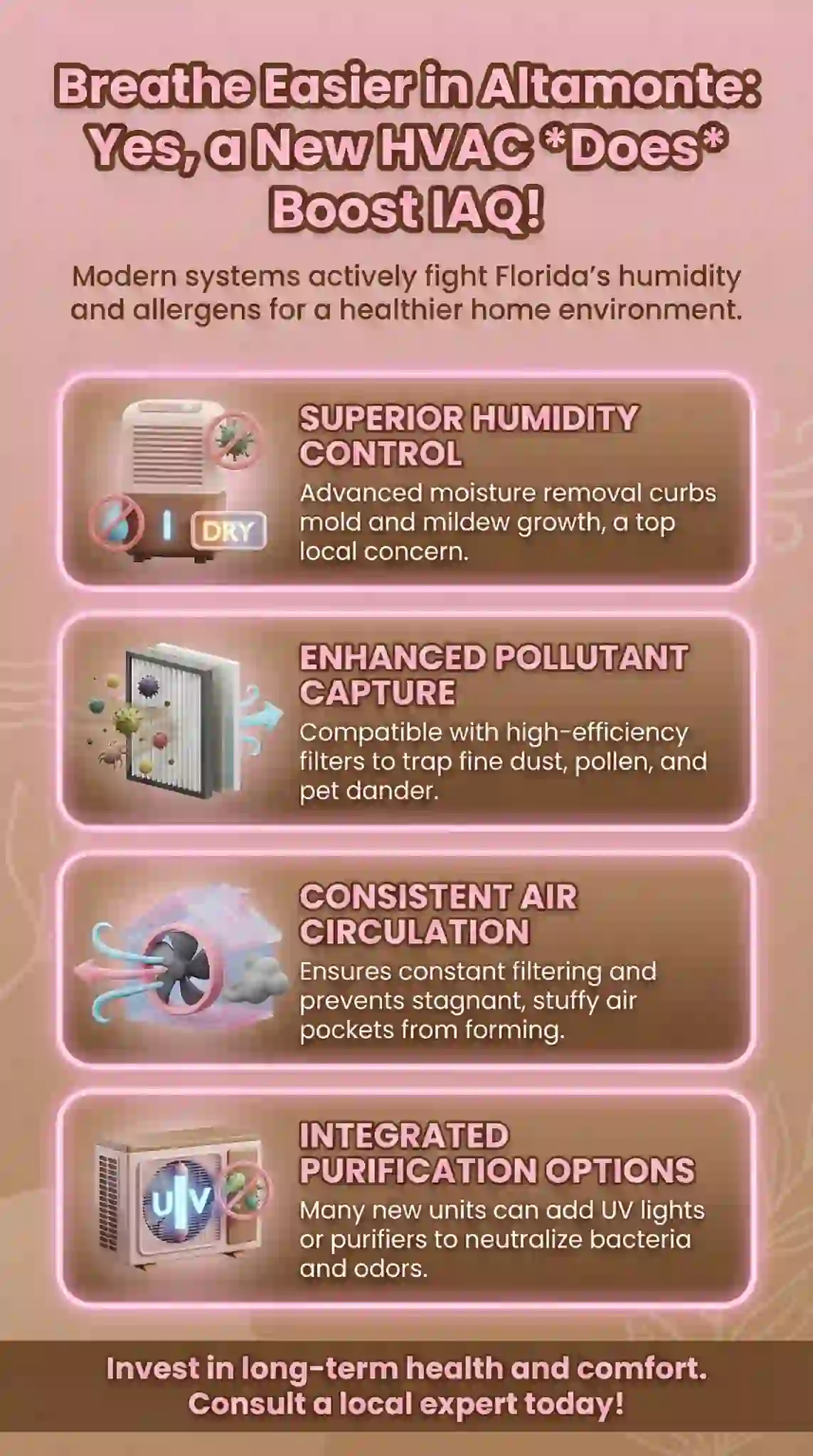
FAQ on How a New HVAC System Improves Indoor Air Quality in Altamonte Springs FL
Q: How does a new HVAC system improve indoor air quality in my Altamonte Springs home?
A: A correctly installed replacement improves indoor air quality through four mechanisms. Most installations only address one.
Dehumidification — Correctly sized systems run full dehumidification cycles. Humidity drops below CDC-recommended 50 percent. Biological conditions mold requires are removed. Oversized systems short-cycle — never complete this cycle — humidity stays elevated regardless of how new the equipment is.
Filtration — MERV 13 captures fine biological particles on every circulation cycle. MERV 8 builder-grade misses most of them. In a sealed Central Florida home with no natural air dilution — what the filter misses recirculates indefinitely.
Ventilation — Properly designed installation meets ASHRAE 62.2 ventilation standards. Only mechanism providing fresh air exchange in a sealed Altamonte Springs home running year-round. Most installations don't address ventilation adequacy. Most homeowners don't know it was skipped.
Duct integrity — Sealed, assessed ductwork delivers conditioned, filtered air without attic air contamination. Without it — every other mechanism is compromised.
What doesn't improve air quality despite new equipment:
Oversized systems short-cycling — never completing dehumidification
New equipment installed on leaking, unassessed duct systems
MERV 13 filters on systems not sized to accommodate airflow resistance
Installations that replaced equipment without evaluating ventilation adequacy
Q: What indoor humidity level should my HVAC system maintain in my Altamonte Springs home?
A: Below 50 percent. That's the CDC threshold for preventing mold and biological pollutant growth — and the number we measure against in every home we assess in this community.
What we find most often in Altamonte Springs homes with aging or improperly sized systems:
Indoor humidity consistently in the low to mid sixties
10 to 15 percentage points above the CDC biological threshold
System is running — just not completing dehumidification cycles
Why 50 percent is a biological threshold — not just a comfort target:
Below 50 percent — mold growth conditions are removed
Above 50 percent — mold conditions maintained regardless of how recently the system was serviced
Dust mite populations thrive above 50 percent — primary trigger for respiratory symptoms
Biological pollutant concentrations increase with every degree above the threshold
What we observe after correct sizing brings humidity below 50 percent:
Mold that returned repeatedly to the same locations stops returning
Allergy and respiratory symptoms reduce within the first few weeks
Home feels lighter and drier before the Duke Energy bill reflects the improvement
Remediation contractors stop getting called — conditions that required them no longer exist
The homes where mold keeps returning despite remediation are almost always running consistently above 50 percent. Correct system sizing is the intervention — not another remediation estimate.
Q: What MERV rating filter should I use with a new HVAC system in my Altamonte Springs home?
A: MERV 13 for most Altamonte Springs homes — but only when the system is sized to accommodate it.
What MERV ratings mean in this community:
MERV 8 — standard builder-grade, misses fine biological particles that recirculate in a sealed home
MERV 11 — captures pet dander and mold spores — meaningful upgrade for allergy sufferers
MERV 13 — captures bacteria, smoke, and respiratory droplets at clinically meaningful rates
Why MERV 13 is the appropriate standard here — not a premium upgrade:
Sealed building envelope — filtration carries the full particle removal burden
Year-round operation — continuous exposure to whatever the filter doesn't capture
High humidity environment — elevates biological particle concentrations year-round
No off-season reset — what the filter misses recirculates indefinitely
The compatibility issue we raise in every filtration conversation:
Higher MERV ratings increase airflow resistance
A system not designed for MERV 13 works harder, consumes more energy, and wears faster
Filtration selection must happen during the sizing conversation — not after installation
We confirm airflow compatibility for every filtration upgrade we recommend
What we've learned consistently: MERV 13 delivers its full benefit when duct condition is addressed at the same time. Better filtration on a leaking duct system still allows unfiltered attic air into living spaces. Addressing both together is what produces the air quality improvement the homeowner is paying for.
Q: Does duct sealing actually improve indoor air quality in Altamonte Springs homes?
A: In every home we've assessed where duct sealing was performed alongside a replacement — yes. Consistently and significantly.
What the DOE documents that our field experience confirms:
Homes lose 25 to 40 percent of conditioned air through duct leaks
In Central Florida attics exceeding 130 degrees — losses reach the higher end consistently
Lost conditioned air is replaced by unconditioned attic air entering living spaces
What that attic air introduces — the part most homeowners never connect to their HVAC system:
Heat and humidity elevating indoor moisture regardless of equipment performance
Biological particles including mold spores and insulation fibers from attic spaces
Unfiltered air bypassing the system's filtration entirely
Pressure imbalances pulling contaminants from wall cavities into conditioned areas
What duct sealing consistently delivers:
Indoor humidity drops — moisture-laden attic air stops entering living spaces
Filtration performs at rated efficiency — bypass air is eliminated
Room-to-room comfort becomes consistent — pressure imbalances corrected
Air quality improvement the new system was installed to deliver actually reaches living spaces
The conversation we have with every homeowner before recommending equipment:
A new high-efficiency system on a leaking duct network delivers a fraction of its rated air quality performance
We've assessed homes where sealing the ducts changed the outcome more than the equipment did
Duct assessment is the conversation before the equipment conversation — not after
Q: How long does it take to see indoor air quality improvement after a new HVAC system installation in Altamonte Springs?
A: When the installation is done correctly — immediately. From the first day of operation.
What homeowners consistently tell us within the first week:
The house smells different. Cleaner. Less musty.
Background humidity that made every room feel heavy is gone
Air feels lighter — drier and more consistent room to room
System runs quieter and less frequently while maintaining better comfort
What typically improves within the first 30 days:
Indoor humidity stabilizes below CDC-recommended 50 percent threshold
Allergy and respiratory symptoms begin to reduce
Mold that returned repeatedly to the same locations stops returning
Duke Energy bills reflect a system running correctly — lower consumption, steadier runtime
What takes longer — and what we tell homeowners upfront:
Homes with significant accumulated biological pollutants need several air exchange cycles to normalize
Existing mold growth still requires remediation — new system removes conditions, not existing growth
Significantly contaminated duct systems may benefit from professional cleaning after sealing
The honest answer we give every Altamonte Springs homeowner:
The improvement timeline is determined by installation quality — not equipment quality.
Correctly sized system with sealed ducts and appropriate filtration: measurable improvement from day one
New system installed without those variables: new equipment smell and the same conditions it replaced
That's the difference between a replacement that resolves the problem — and one that defers it.
In Will a New HVAC System Improve Indoor Air Quality in My Altamonte Springs Home?, we explain that better air quality doesn’t come from new equipment alone—it comes from correct sizing, proper airflow, humidity control, and filtration that matches the system’s design. After installation, choosing the right filter helps preserve those gains, whether that’s a properly fitted HVAC air filter replacement to maintain designed airflow, a reliable MERV 8 HVAC air filter for consistent everyday dust and debris capture, or a higher-efficiency MERV 13 HVAC air filter for stronger fine-particle reduction in homes sensitive to allergens. When installation quality and filtration strategy work together, homeowners are far more likely to see measurable improvements in comfort, humidity balance, and overall indoor air quality from the first full cooling cycle onward.