
Shut a warm car in your garage and the engine bay keeps radiating heat into that space for the next two hours. Almost nobody factors it in. They buy a garage air conditioner sized off the square footage, plug it in, and then wonder why the room is still punishing at two in the afternoon.
The equipment usually isn’t the problem. I’ve walked into plenty of garages where the unit was perfectly capable and the building was doing all the losing. A garage sits outside your home’s ducted system, carries an uninsulated door roughly the size of a wall, and holds a slab that soaks up heat from sunrise onward. Any of the usual air conditioning approaches will pull the temperature down for a while. One of them holds it there. Here is how the four options compare, and what actually breaks each one.
TL;DR Quick Answers
Garage air conditioner
A garage air conditioner has to fight an uninsulated door, a heat-storing slab, and a warm car, so plan on 12,000 to 18,000 BTU for a two-car space. A ductless mini split handles that load best. Your electrical panel, not the price tag, usually decides what you can install.
Best option: ductless mini split for a garage you use regularly
Typical size: 12,000 to 18,000 BTU for 400 to 600 square feet
Power required: 115V up to about 12,000 BTU, 230V above that
Cheaper route: dual-hose portable, never single-hose
Highest return per dollar: insulate the garage door before you buy anything
Top Takeaways
A garage runs hot because it has no insulation worth the name, no tie-in to your central ductwork, and heat sources sitting inside it that a bedroom never has to deal with.
Fans move air without removing heat, so they cannot beat outdoor temperature. Run one after sunset to flush the day out of the slab.
Single-hose portables pull replacement air in from outdoors and undercut their own cooling. Dual-hose is the only portable worth your money.
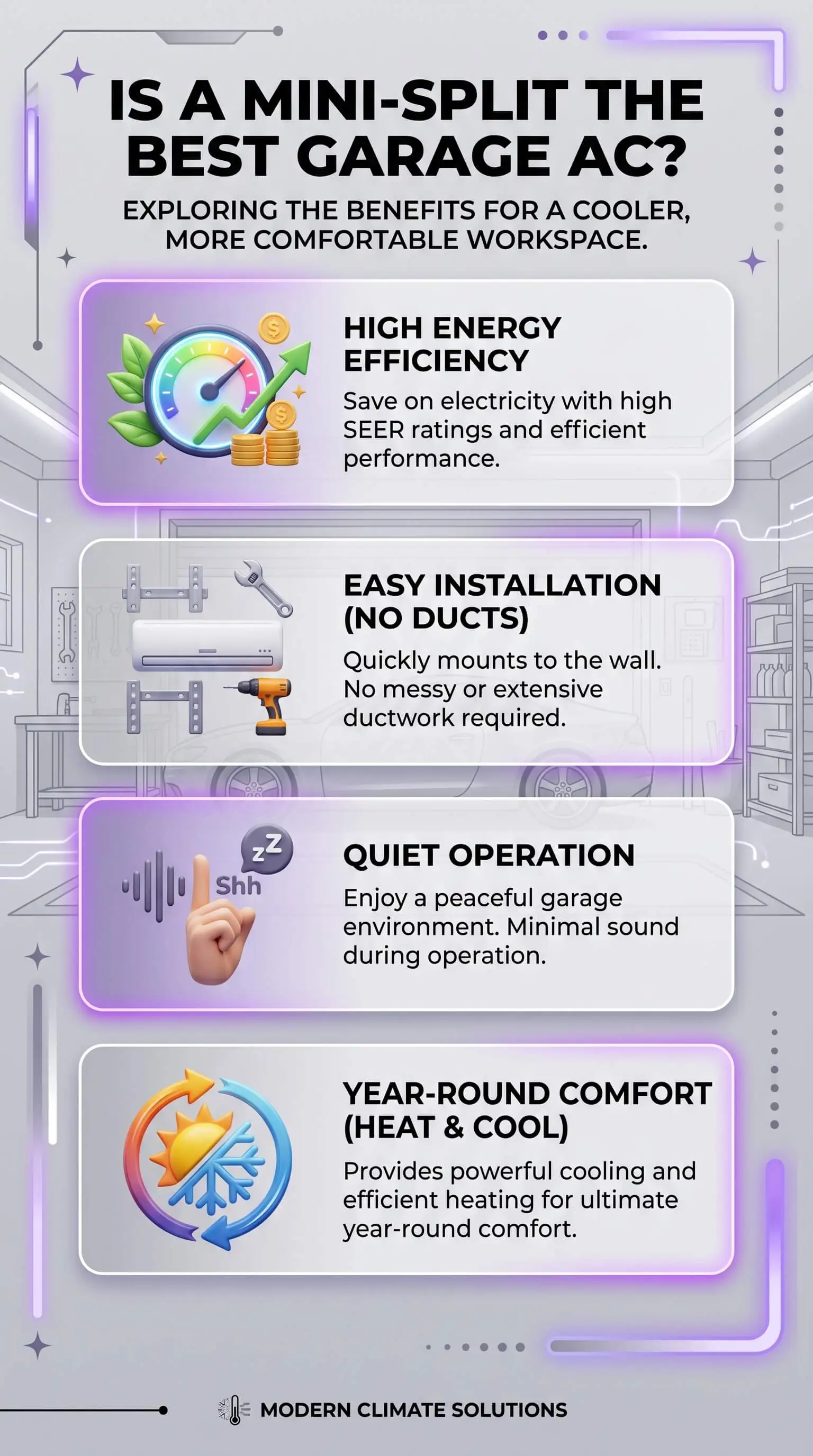
A ductless mini split fits a garage in regular use better than anything else, because it needs no window, runs quiet, modulates its output, and heats as well as cools.
Sizing sinks fewer installs than these two do: a panel that cannot deliver a dedicated 230V circuit, and no plan for where the condensate drains.
Why a garage beats an ordinary air conditioner
Your bedroom has insulated assemblies on five of six sides and a register feeding it conditioned air every minute the system runs. Your garage has neither, and that gap is wider than most people picture.
Start with the door. One layer of uninsulated steel, facing full afternoon sun, and steel does not simply pass heat along. It stores it, then keeps radiating inward long after the sun has swung off the west wall. Put your hand flat on the inside of a garage door at seven in the evening sometime. You will pull it back.
Then everything inside piles on. A car you drove twenty minutes ago carries a hot engine, hot exhaust, brake rotors still shedding heat, and a radiator fan that may keep cycling after you have gone in for dinner. A chest freezer or a spare refrigerator in the corner dumps its waste heat straight into the air it is trying to escape. I have measured garages sitting more than 20 degrees above the shade temperature outside with nothing running in them at all.
That gives me the rule I work from. Capacity that would feel generous in a bedroom is barely adequate in a garage of identical square footage, especially when high quality filters are part of a well-maintained cooling system.
Fans and ventilation, and where they stall out
A fan removes no heat whatsoever. It moves air across skin, speeds up evaporation, and makes you feel cooler while the thermometer sits exactly where it was. Exhaust fans do more honest work, because they physically shove hot air out of the building, but they top out at outdoor temperature. On a 95 degree afternoon, outdoor temperature is the entire problem.
Ventilation earns its keep after dark. Run an exhaust fan through the evening and it draws the day’s stored heat out of the slab and the framing, so whatever you install for real cooling wakes up the next morning at a lower starting point, with pleated furnace filters helping support cleaner airflow in compatible HVAC systems. Treat it as a supporting move rather than the answer.
Portable units, and the single-hose trap
Portables fail on physics rather than price, and the failure is designed into the version most people take home.
A single-hose unit pulls air from inside the garage, runs it across the coil, and blows the hot side out through one duct. That exhausted air has to be replaced by something. It gets replaced by outdoor air, dragged in through every gap around the door, which means you are cooling the room and importing the heat to refill it in the same breath. You can watch the effect on a thermometer sitting near the threshold.
Dual-hose models solve most of that by taking condenser air from outside instead of from the room around you. Go portable and dual-hose is the only version I would buy. You will still babysit a drain bucket or run a hose out a gap, and the unit will stand on the floor occupying the exact square footage you were trying to reclaim.
Window units, and the two things that usually end the conversation
A window air conditioner is the cheapest honest cooling per BTU you can buy, and in a garage with a suitable window it is a defensible choice. I have recommended it more than once.
Two problems keep showing up. Plenty of garages have no window at all, and cutting an opening into a wall is a framing and flashing job rather than a Saturday project. Then there is the noise. A window unit parks its compressor about four feet from your head, which you sleep through in a bedroom and notice constantly in a shop where you are listening for a tool binding or a bearing beginning to whine.
Ductless mini splits, and what actually stops them
A ductless mini split puts the loud half of the system outside and leaves a quiet air handler on the wall, which clears the window requirement, the floor space, and the drain bucket in one move.
The part that matters more than any of that is the compressor. An inverter modulates its output instead of slamming on and off, and modulation is what holds a steady temperature in a room whose heat load changes every time the door rolls up.
It also heats, which nothing else on this list does. For a garage pulling double duty as a gym or a shop, that converts a three-season space into one you will actually use in January.
The drawbacks are real and I am not going to soften them. Cost is one. The other is that this is not a plug-in appliance. Refrigerant lines have to be evacuated and charged, which puts a licensed technician on your property. If you want a fuller breakdown of garage cooling options, read the sizing guidance alongside the comparison before you start collecting quotes rather than after.
What size garage air conditioner do you actually need?
Start with published capacity guidance, then adjust for the fact that a garage is not a bedroom.
The ENERGY STAR room sizing table puts 450 to 550 square feet at 12,000 BTU per hour and 550 to 700 square feet at 14,000, calculated on an eight-foot ceiling, with a 10 percent increase for a very sunny space. Most two-car garages measure 400 to 600 square feet, which lands you in the 12,000 to 18,000 band. If your door faces west with no insulation in it, treat that sunny-space adjustment as your floor rather than your ceiling.
Then stop.
Rounding up two sizes because bigger feels safer will cost you comfort. An oversized unit drags the temperature down fast, satisfies its thermostat, and shuts off before it has run long enough to strip moisture out of the air. ENERGY STAR puts the result in plain words: cool, damp, and clammy. Add a concrete slab and a car dragging rainwater in behind it, and that is how you end up with condensation forming on your tools.
The two checks almost nobody makes before buying
Your electrical panel. A 12,000 BTU unit is commonly sold in both 115V and 230V. Go above 12,000 and you are into 230V, which means a dedicated two-pole breaker and a home run out to the garage. If your panel is full, or the garage hangs off a single shared 15 amp circuit that also feeds the door opener and the lights, the wiring is the project and the air conditioner is the easy part. Price the circuit first. I have watched that one number change which unit somebody bought.
Where the water goes. Every air conditioner makes condensate, and in a humid climate a garage unit makes a great deal of it. A wall-mounted air handler drains by gravity when there is somewhere downhill to send it. When the mounting spot sits below the exit point, you need a condensate pump, which is one more component that needs power and will eventually quit on you. Settle this while you are still standing on the floor, not when the installer is up a ladder holding the bracket.
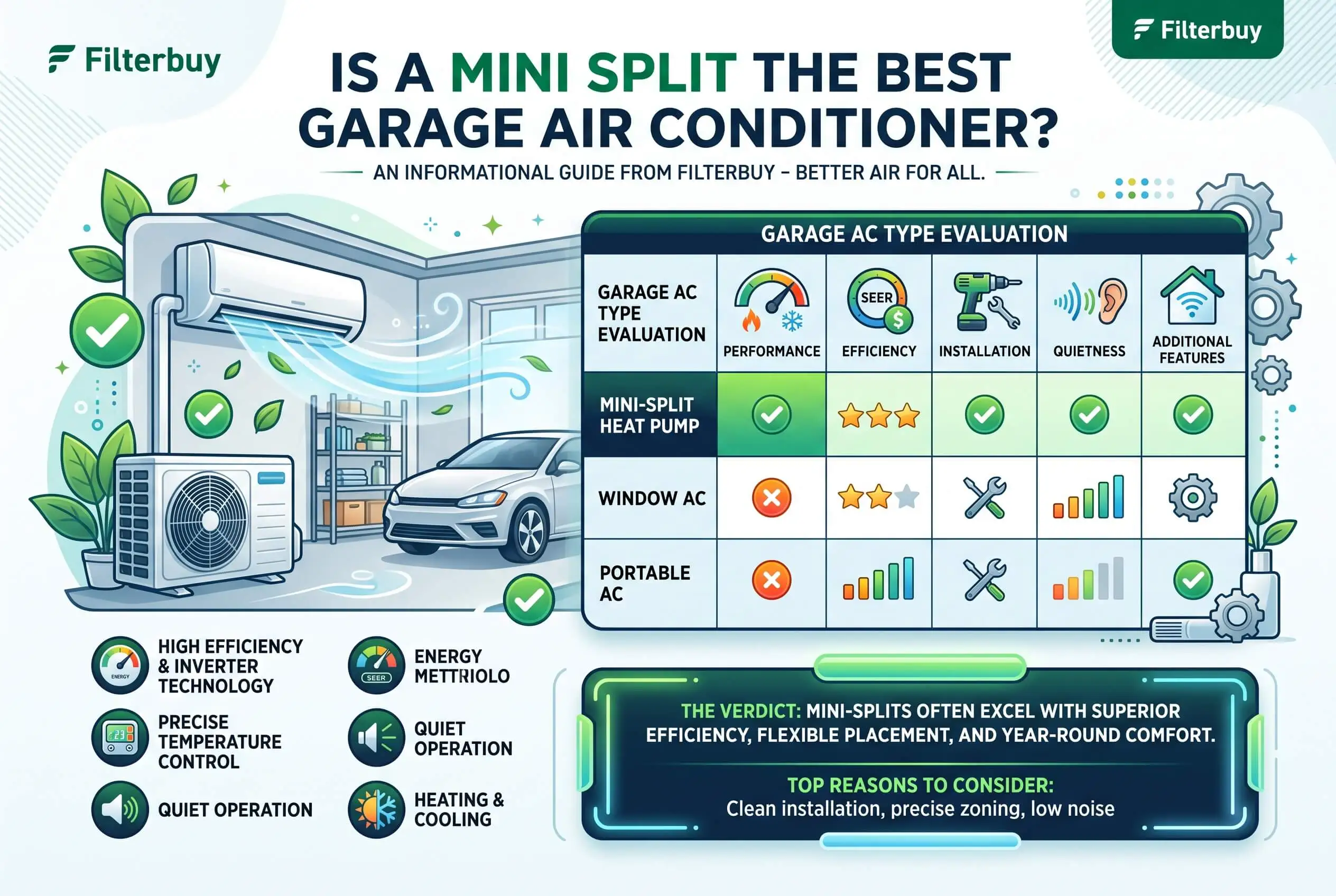
“Most of the time the unit is not undersized at all. It is a correctly sized head losing to an uninsulated door on a west wall, and I have watched the same 12,000 BTU system go from running flat out to cycling normally with nothing changed but a foam panel kit going into that door.”
7 Essential Resources
1. Check whether a ductless system actually suits your garage
Garages and outbuildings show up by name on this page as spaces where extending ductwork makes no sense and a mini split does. It also states plainly that a contractor should verify capacity with a Manual J calculation instead of eyeballing square footage. Source: ENERGY STAR, Ductless Heating and Cooling.
2. Size the unit from the same table the industry sizes from
Capacity by floor area, adjustments for sun and occupancy, and a direct warning that an oversized unit cools before it dehumidifies. Print this one and bring it to a sizing argument. Source: ENERGY STAR, Room Air Conditioners.
3. Cut the load before you spend a dollar on equipment
Air sealing and insulation projects sorted by effort, budget, and payoff, with recommended R-values by region. ENERGY STAR puts the combined savings at up to 10 percent of an annual energy bill, and in a garage the comfort difference lands harder than that number suggests. Source: ENERGY STAR, Seal and Insulate.
4. Confirm the rating instead of trusting the box
Efficiency claims get independently certified here, and any quote you accept should carry an AHRI reference number for the full matched system rather than a single component. Source: Air-Conditioning, Heating, and Refrigeration Institute, AHRI Directory.
5. Hand your installer a checklist and watch the bid change
The Department of Energy publishes contractor checklists for air conditioner and heat pump replacement that you can attach directly to a work agreement. Handing one to a bidder changes the tone of the visit within about ninety seconds. Source: U.S. Department of Energy, Building America Solution Center.
6. Know what you are sealing into the room with you
Tightening a garage improves cooling and concentrates whatever is already floating in there. EPA names automobile emissions in attached garages, alongside stored fuels and paint supplies, as a leading indoor source of benzene. Read this before you caulk every last gap. Source: U.S. Environmental Protection Agency, The Inside Story.
7. Ask the questions that separate a contractor from a price
Ten specific things to settle before you sign, including the expectation that a contractor inspects your space and sizes the system rather than quoting off a phone call. Source: ENERGY STAR, 10 Tips for Hiring a Heating and Cooling Contractor.
These resources cover garage mini split suitability, proper system sizing, insulation, efficiency verification, installer selection, indoor air quality, and the value of HVAC system maintenance services for keeping a properly installed garage cooling system efficient and reliable
3 Statistics
Air conditioning used about 19 percent of household electricity in 2020. That works out to roughly 254 billion kilowatt-hours. Efficiency is no rounding error on a space you plan to cool all summer. Source: U.S. Energy Information Administration.
More than 200 people in the United States die each year from accidental non-fire carbon monoxide poisoning tied to consumer products. More than 100 of those deaths involve portable generators. A tighter garage raises the stakes on anything that burns fuel inside it. Source: U.S. Consumer Product Safety Commission.
Among new single-family homes sold in the South in 2024, 75 percent came with a two-car garage. Another 10 percent had a one-car. Two-car is the default case, which is why 12,000 to 18,000 BTU covers most readers. Source: U.S. Census ‘Bureau, Characteristics of New Housing.
These statistics highlight how much energy garage cooling can use, why carbon monoxide safety matters in enclosed spaces, and why two-car garages are such a common sizing case, with MERV 13 pleated HVAC furnace air filters helping support cleaner airflow in compatible HVAC systems.
Final Thoughts and Opinion
Ask me for one answer and it is the mini split, though the reason has less to do with raw power than with the fact that it solves the whole problem at once. Quiet. No window needed. Nothing standing on your floor. A steady temperature under a load that swings every time the door opens, and heat when it is 40 degrees out and you still want to lift.
The trade-off deserves an honest hearing. You are paying several times what a window unit costs and hiring a licensed technician instead of lifting a box into a frame yourself. For a garage you open twice a month to grab a rake, that is a poor use of money, and a dual-hose portable is the sensible call. I would tell you the same thing standing in your driveway.
The math flips when the garage stops being storage and turns into a room you spend hours in. Gym, shop, office, whatever you are building in there. At that point you are buying usable square footage rather than an appliance, and the cheap options quietly stop being cheap because you never end up using the space you paid to cool.
One more opinion, and it is the one I would argue hardest for. Insulate the door first. I have seen a foam panel kit do more for a garage than an extra 6,000 BTU ever managed, and it costs a fraction as much, even before considering Top HVAC system installation options.
Frequently Asked Questions
Is a mini split the best garage air conditioner?
For a garage you use regularly, yes. It runs without a window, occupies no floor space, holds a steady temperature under a swinging load, and heats in winter. If the space is storage only, a dual-hose portable or a window unit gives you far better value.
What size air conditioner do I need for a two-car garage?
Most two-car garages measure 400 to 600 square feet, which points to 12,000 to 18,000 BTU per hour. Add capacity for an uninsulated west-facing door or a ceiling above eight feet. Then hold it there. A unit that short-cycles will leave the space damp rather than comfortable.
Can a garage air conditioner run on a standard outlet?
Up to roughly 12,000 BTU, often yes, on a dedicated 115V circuit. Above that you generally need 230V, a two-pole breaker, and new wiring out to the garage. Check your panel before you choose equipment, because the electrical work can outprice the unit.
Do I have to insulate the garage before installing air conditioning?
You do not have to. The unit will simply run longer, cost more to operate, and struggle on the worst afternoons. Insulating the door returns the most per dollar, because that one large uninsulated panel is usually the biggest source of heat gain in the building, helping you get more value from your AC unit installation costs by reducing the need for a larger, more expensive system.
Will a mini split work in a garage with no windows?
Yes, and that is one of its strongest arguments. The indoor air handler mounts on any suitable wall and connects to the outdoor unit through a small penetration carrying the refrigerant lines and condensate drain, so no window or existing opening is required.
Why does my garage stay hot even with a big fan running?
A fan moves air without removing heat, so you feel cooler while the temperature holds. An exhaust fan can vent hot air out, but it can only reach outdoor temperature. Actually cooling the space takes a refrigeration cycle, which means an air conditioner.
Pick the Garage Air Conditioner Your Space Actually Needs
Run a tape measure across the floor, open your electrical panel and count what is genuinely free in there, then work out where the condensate would drain and how easily you can access the air conditioner filter for routine cleaning. Those answers will point you at the right unit faster than any spec sheet on any product page.