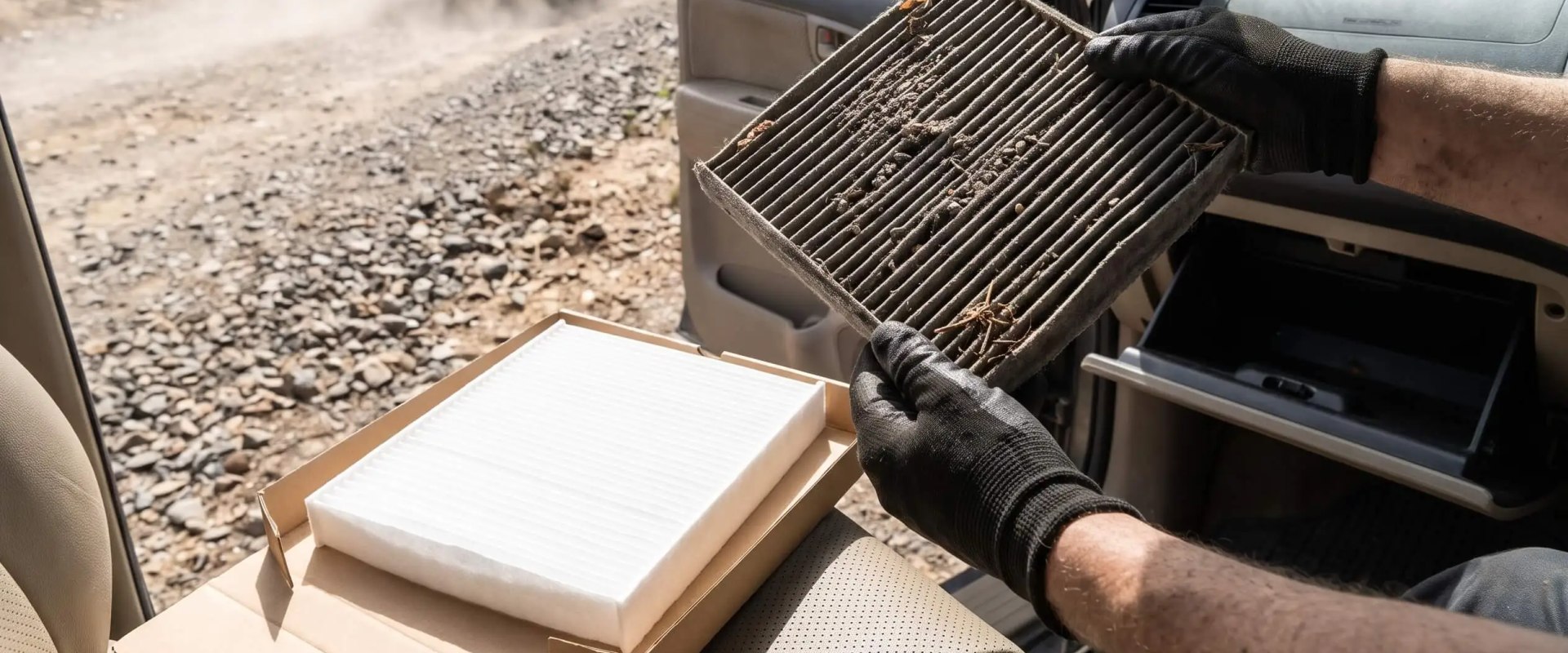
Pull the cabin air filter from a car that spends its weeks on gravel roads, and there's a good chance you'll find the pleats packed with tan dust months before the calendar says it's due. So yes, gravel driving raises your cabin air filter replacement cost. Each filter costs about what it would on pavement. You just end up buying more of them.
That dust comes off the road every time your tires roll over it, and your car's cabin air filter sits right in its path, catching whatever the intake at the base of your windshield pulls in. The bill never stings at the counter. It adds up over the years.
TL;DR Quick Answers
cabin air filter replacement cost
A cabin air filter replacement costs about $60 to $130 at a repair shop and $15 to $50 if you do it yourself. Roughly half of a shop bill is labor for a 10- to 15-minute swap, so the filter’s location and how often you replace it decide what you pay each year.
At a shop: About $60 to $130, with dealerships usually at the high end.
Do it yourself: $15 to $50, which is the price of the filter alone.
Labor share: About half of the shop bill, for a job most cars allow without tools.
How often: Every 12,000 to 15,000 miles or once a year on most vehicles.
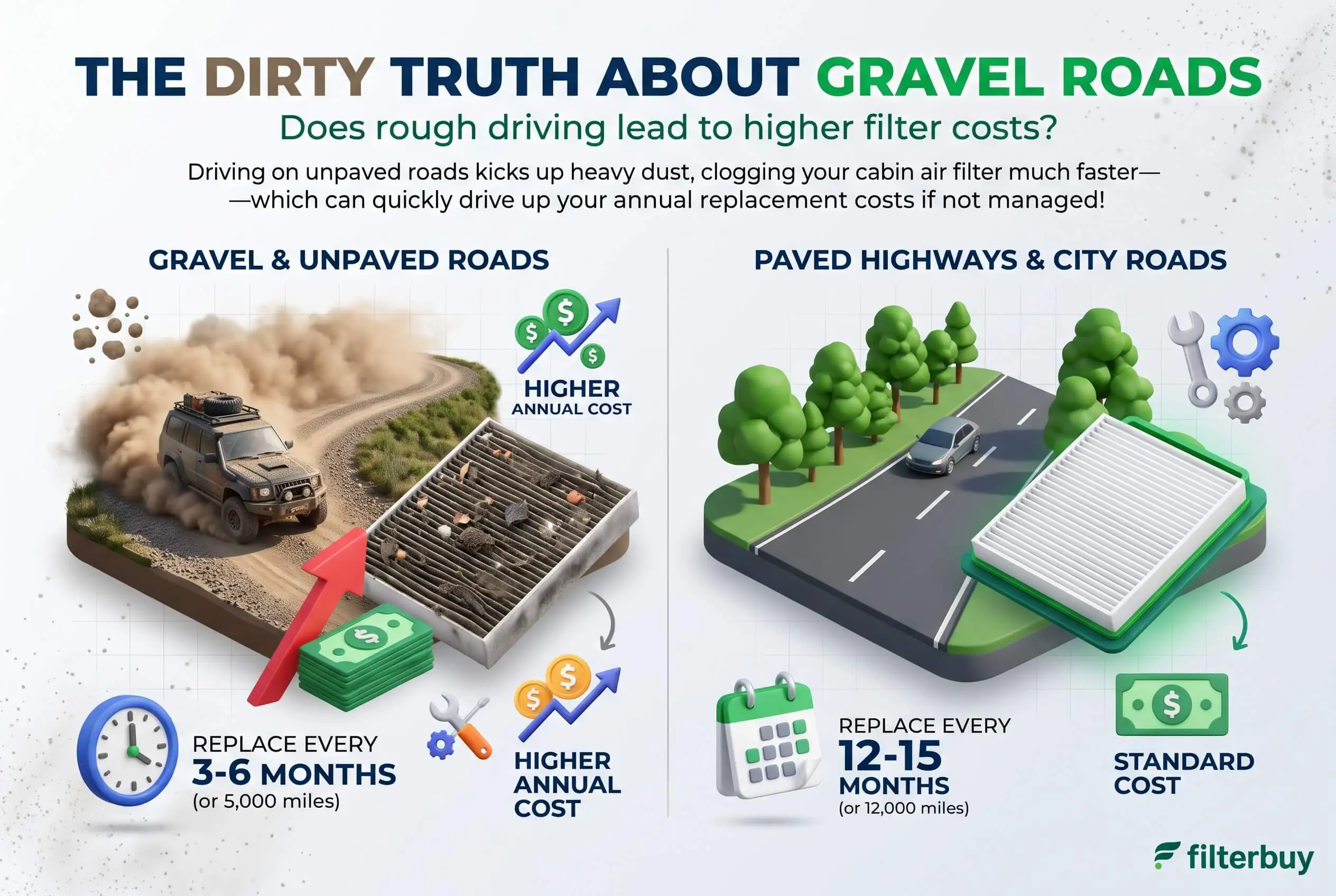
Gravel or dusty roads: Plan on two to three changes a year, which can double or triple your yearly cost.
Easiest savings: A filter behind the glove box is a simple DIY swap that skips the labor charge.
Top Takeaways
A single replacement costs about the same on gravel. You just need them more often.
Regular gravel driving can double or triple your yearly cabin air filter replacement cost.
Many owner's manuals list graveled and unpaved roads as a severe driving condition.
Check the filter at every oil change and replace it by what you see, not by the calendar.
Recirculation, closed windows, and doing the swap yourself are the easiest ways to keep costs down.
Why Gravel Roads Clog a Cabin Air Filter Faster
Your tires grind loose gravel into fine silt, and every truck or car ahead of you lifts it into a cloud that hangs over the road. Your ventilation system draws fresh air from a cowl intake just below the windshield. That puts it low, and right in the dust.
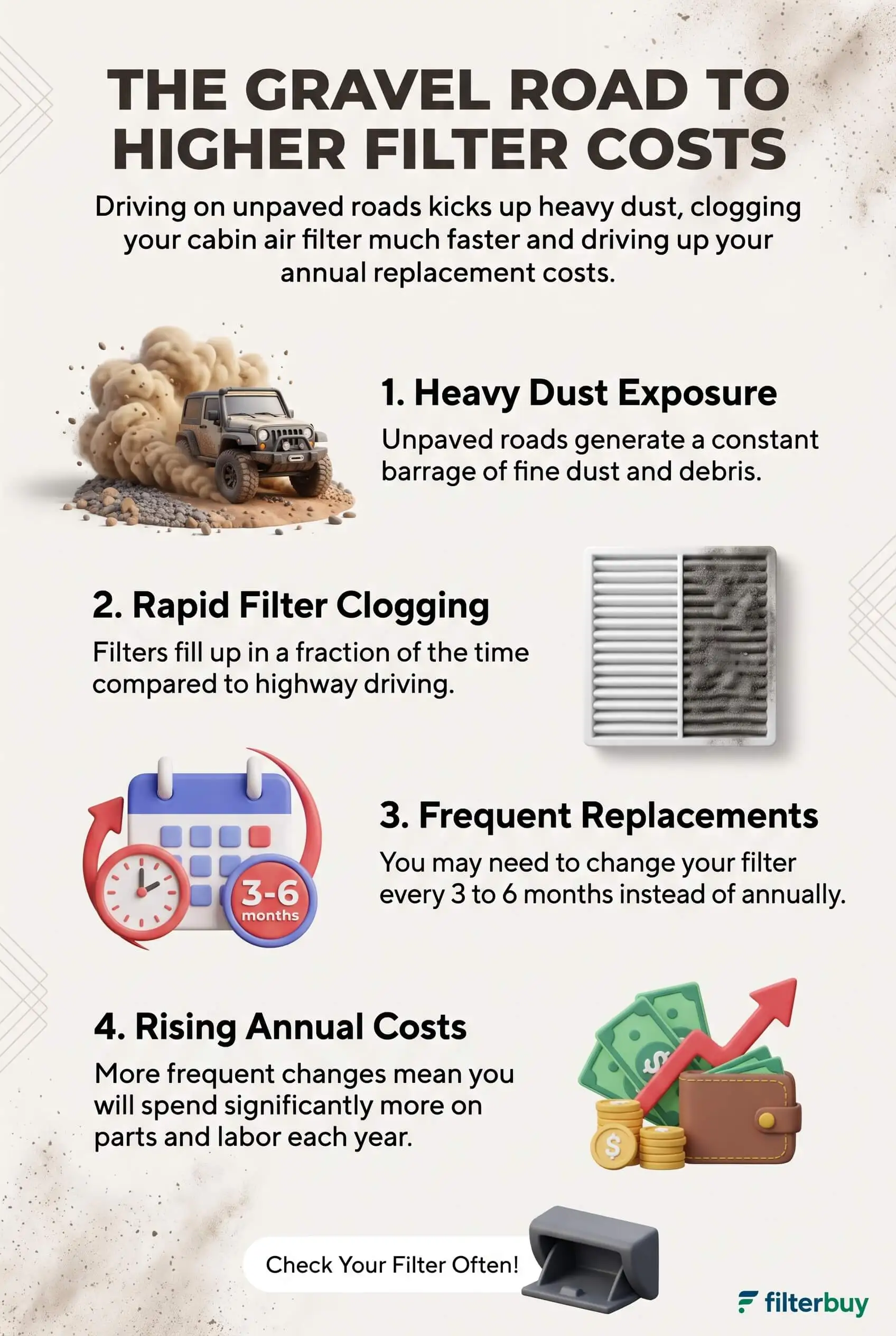
The filter does exactly what it should and traps the grit. Volume is the problem. Gravel dust packs into the pleats far faster than the pollen and soot you'd pick up on a paved commute.
Once the pleats fill, less air makes it through. Your blower works harder, the vents start to feel weak, and both the AC and the defroster lose strength, since cabin temperature depends on how much air crosses the evaporator and heater core.
What You'll Notice When Gravel Dust Builds Up
Vents that feel weak even with the fan on high
A blower that's gotten noticeably louder
Windows that fog up and clear more slowly than they used to
A dusty or musty smell the moment the fan starts
Tan grit packed between the pleats when you pull the filter
How Gravel Driving Changes Your Cabin Air Filter Replacement Cost
Gravel won't change what you pay for any single replacement. Most repair shops charge roughly $60 to $130, and a DIY swap costs only the filter, usually $15 to $50. About half of that shop bill is labor, for a job that takes 10 to 15 minutes on most cars.
Frequency is where gravel gets expensive. I built this estimate from those published ranges.
Mostly paved roads: one replacement a year, or about $15 to $50 DIY and $60 to $130 at a shop
Regular gravel driving: two to three replacements a year, or about $30 to $150 DIY and $120 to $390 at a shop
Stretching a clogged filter costs you in other ways. Your blower motor stays under extra strain. And on a cold, damp morning, glass that clears slowly cuts into how well you can see the road, which moves this from a comfort issue to a safety one.
Does Your Owner's Manual Call Gravel a Severe Driving Condition?
Plenty of them do. Kia's severe usage schedule lists driving on rough, dusty, muddy, unpaved, graveled, or salt-spread roads as a severe condition, and it tells owners to replace the cabin air filter more often when that applies. Most automakers set a standard interval of about 12,000 to 15,000 miles or once a year, then shorten it for dusty driving.
Flip to the section titled "maintenance under severe usage conditions" or "special operating conditions." When gravel shows up in most of your weeks, that's the schedule written for you.
How to Protect Your Cabin Air Filter on Gravel Roads
Switch to recirculation on gravel stretches. Your system reuses the air already in the cabin instead of pulling in the dust cloud outside. Flip back to fresh air once you hit pavement so the windows stay clear.
Keep the windows up. Open windows let grit settle into the intake side of the system and across everything in the cabin.
Leave extra room behind the car ahead. The thickest dust hangs a few car lengths behind another vehicle.
Check the filter at every oil change. Pull it, look at the pleats, and let what you see set the schedule.
Swap it yourself when it sits behind the glove box. Most do, and handling the job yourself drops the labor half of the bill.
Bring your own filter when a shop does the work. Most shops will install a part you supply, which skips their parts markup.
Cabin Air Filter vs. Engine Air Filter on Dusty Roads
These two parts do different jobs. Your cabin air filter cleans the air you and your passengers breathe, and the engine air filter cleans the air your engine burns. Gravel shortens the life of both, so check them at the same time. On a modern fuel-injected engine, a clogged engine air filter mostly dulls acceleration rather than fuel economy. Unlike automotive filters, MERV 8 pleated furnace air filters are designed to capture airborne particles in your home's heating and cooling system.
"In my experience, filters that come out of gravel-road cars are never evenly gray. The front face of the pleats is packed with tan grit while the back still looks almost new, and that tells me road dust ended that filter's life well before the mileage did."
Essential Resources
1. Know What You Should Pay Before You Book
Before you hand over your keys, check this breakdown of what a cabin air filter replacement costs at a shop versus doing it yourself. It separates parts from labor and lists prices for common vehicles.
2. FTC: Auto Repair Basics
Spells out what a written estimate should include and why you should sign off on any work beyond it. That keeps a simple filter swap from turning into a padded bill.
Source: https://consumer.ftc.gov/articles/0211-auto-repair-basics
3. AirNow: AQI Basics
Learn how the Air Quality Index works, so you can spot the dusty, high-particle days when recirculation matters most.
Source: https://www.airnow.gov/aqi/aqi-basics/
4. American Lung Association: Particle Pollution
A plain-language look at what particle pollution is, where it comes from, and how it affects your lungs and heart.
Source: https://www.lung.org/clean-air/outdoors/what-makes-air-unhealthy/particle-pollution
5. CDC: About Air Quality
Practical guidance for planning around outdoor air pollution, with links for families with kids, travelers, and anyone managing a heart or lung condition.
Source: https://www.cdc.gov/air-quality/about/index.html
6. FuelEconomy.gov: Keeping Your Vehicle in Shape
Clears up what a clogged engine air filter does and doesn't do to performance. Handy when you check both filters after a dusty season.
Source: https://www.fueleconomy.gov/feg/maintain.jsp
7. California Air Resources Board: Unpaved Road Dust
California's emissions method for estimating how much inhalable dust vehicles kick up on unpaved roads.
Source: https://www.arb.ca.gov/ei/areasrc/fullpdf/full7-11.pdf
These resources explain cabin air filter replacement costs, vehicle maintenance, and how road dust and air pollution affect air quality, helping you choose the top air filters for your vehicle and know when to replace them.
Supporting Statistics
1. Nearly a Third of Public Roads Are Unpaved
In 2018, about 1.3 million of the roughly 4.16 million miles of U.S. public roads were unpaved, close to 32 percent.
For millions of rural drivers, that gravel is part of the daily commute.
Source: https://www.fhwa.dot.gov/policyinformation/statistics/2018/hm12.cfm
2. Repair Prices Keep Climbing
Motor vehicle maintenance and repair prices rose 4.9 percent from January 2025 to January 2026.
Every extra shop visit for a filter swap now costs a little more than it did a year ago.
Source: https://www.bts.gov/newsroom/transportation-consumer-price-index-january-2026
3. Road Dust Is Small Enough to Breathe Deep
The EPA lists dust from unpaved roads as a direct source of particle pollution and notes that an average human hair is about 30 times wider than the largest fine particle.
Your cabin air filter is there to catch those particles before they reach your lungs.
Source: https://www.epa.gov/pm-pollution/particulate-matter-pm-basics
Final Thoughts and Opinion
Here's where I land. On gravel roads, the calendar is the wrong tool for timing a cabin air filter change. The pleats tell you everything, and checking them takes about a minute.
You control the two things that set your yearly cost: how often you replace the filter and who does the work. Check it at every oil change, swap it yourself when it sits behind the glove box, and switch to recirculation on the dustiest stretches. Do that, and the filter gets back to its actual job of protecting the air you and your family breathe on every drive.
Frequently Asked Questions
How often should I replace my cabin air filter if I drive on gravel roads?
Check it at every oil change, or roughly every six months. Many gravel-road drivers end up replacing it two or three times a year instead of once. Let the pleats make the call, and follow your manual's severe-condition schedule.
Does a dirty cabin air filter affect AC performance?
Yes. A clogged filter chokes the airflow across the evaporator, so your AC blows weaker and your defroster takes longer to clear the glass. Your blower motor works harder too, and that extra strain adds wear over time. That's why checking and replacing the cabin air filter should be part of your regular vehicle HVAC maintenance.
Is it worth paying a shop to replace a cabin air filter?
That depends on where your filter sits. Most live behind the glove box and take 10 to 15 minutes with no tools, so doing it yourself saves the labor charge. A filter tucked under the dash or cowl is often worth a shop visit.
Can I clean a cabin air filter instead of replacing it?
Not really. Tapping out loose debris buys you a little time, but fine dust lodges deep in the media, and washing a paper filter can ruin it. A fresh filter is the fix you can count on.
Do gravel roads clog the engine air filter too?
Yes. Your engine air filter breathes the same dust, so its interval often gets shorter as well. Check both at the same visit, since each one protects something different.
Keep Gravel Dust From Driving Up Your Filter Costs
Pull your cabin air filter at your next oil change and let the pleats set your replacement schedule. That one-minute habit keeps your vents strong and the air in your car clean, and it holds your yearly filter cost steady on every gravel mile ahead.