
A clay tile roof can look perfect in the listing photos while the felt paper underneath it has been drying out for years. You won't spot that from the driveway. Most buyers don't find out until the first heavy winter storm finds the gap.
We've been roofing in Santa Barbara since 1996, and the same problems come up again and again when a home changes hands: a roof that's older than the seller remembers, worn underlayment hiding under good-looking tile, a covering that doesn't meet the city's fire rules, slow leaks at the flashing, and attics that trap heat and moisture. Any one of these can turn into a bill in the thousands after you get the keys.
When we talk about a roof, we mean the whole assembly, from the covering and underlayment down to the decking, flashing, gutters, and vents. Each part wears out on its own schedule, which is why a glance at the surface tells you so little.
TL;DR Quick Answers
Roofing Santa Barbara
Roofing in Santa Barbara has to stand up to strong sun, salt air, marine-layer moisture, and the city's high fire construction rules. In our experience, the problems that cost owners and buyers the most sit under the surface, not on it.
Check the underlayment on tile roofs. Clay and concrete tile can last 100+ years, but felt underlayment is rated for 15 to 30, so a good-looking tile roof can still leak.
Confirm roof age in writing. Invoices and the reroof permit tell you more than a seller's estimate.
Know the fire rules. In High Fire Hazard Areas, repairs and reroofs need Class A or noncombustible coverings, and wood shakes aren't allowed.
Watch the coast. Salt air corrodes flashing and fasteners, so leaks often start where the roof meets a wall, chimney, or skylight.
Get a dedicated roof inspection. A general home inspection may not include a full roof walk, and a written, itemized report gives you leverage to negotiate.
Hire licensed and local. Quality Roofing of Santa Barbara (CSLB #504492) has served Santa Barbara, Goleta, and Montecito since 1996 and offers free on-site estimates.
Top Takeaways
Confirm the roof's age with invoices and permit records, not the seller's memory.
On a tile roof, ask about the underlayment, since it can wear out decades before the tile does.
In High Fire Hazard Areas, Santa Barbara requires Class A or noncombustible coverings on repairs and reroofs, and wood shakes aren't allowed.
Walk the house looking for ceiling stains, fresh paint patches, rusted flashing, slipped tiles, and overflowing gutters.
Leaks and poor ventilation can reach your attic, insulation, ducts, HVAC equipment, and indoor air.
A general home inspection may not include a full roof walk, so book a separate roof inspection before your contingencies expire.
Bring a written, itemized roof report to the table when you ask for repairs, a credit, or a lower price.
Why Does Roofing in Santa Barbara Wear Out Differently?
Snow and hail almost never reach our roofs. The wear here comes slowly, from strong sun and salt air and a damp marine layer, with a fire season on top that keeps reshaping the building code. Coastal air corrodes metal flashing and fasteners. The morning marine layer keeps underlayment and decking damp for hours, then the afternoon sun bakes shingles and sealants dry. And when a big winter storm does roll in, it tests every weak seam on the roof in a single night.
Where the house sits matters, too. A beach-adjacent home in Carpinteria wears differently than a hillside home in Mission Canyon or up on the Riviera. Before you fall in love with a listing, find out how close it sits to the ocean and how close it sits to open brush.
How Old Is the Roof, and What's Under the Tile?
Confirm the roof's age with paperwork. A seller's memory isn't enough, and "about ten years" has a way of turning out to be twenty. Ask for the original roofing invoice, any warranty documents, and the reroof permit. The permit shows when the work happened and whether the city signed off on it.
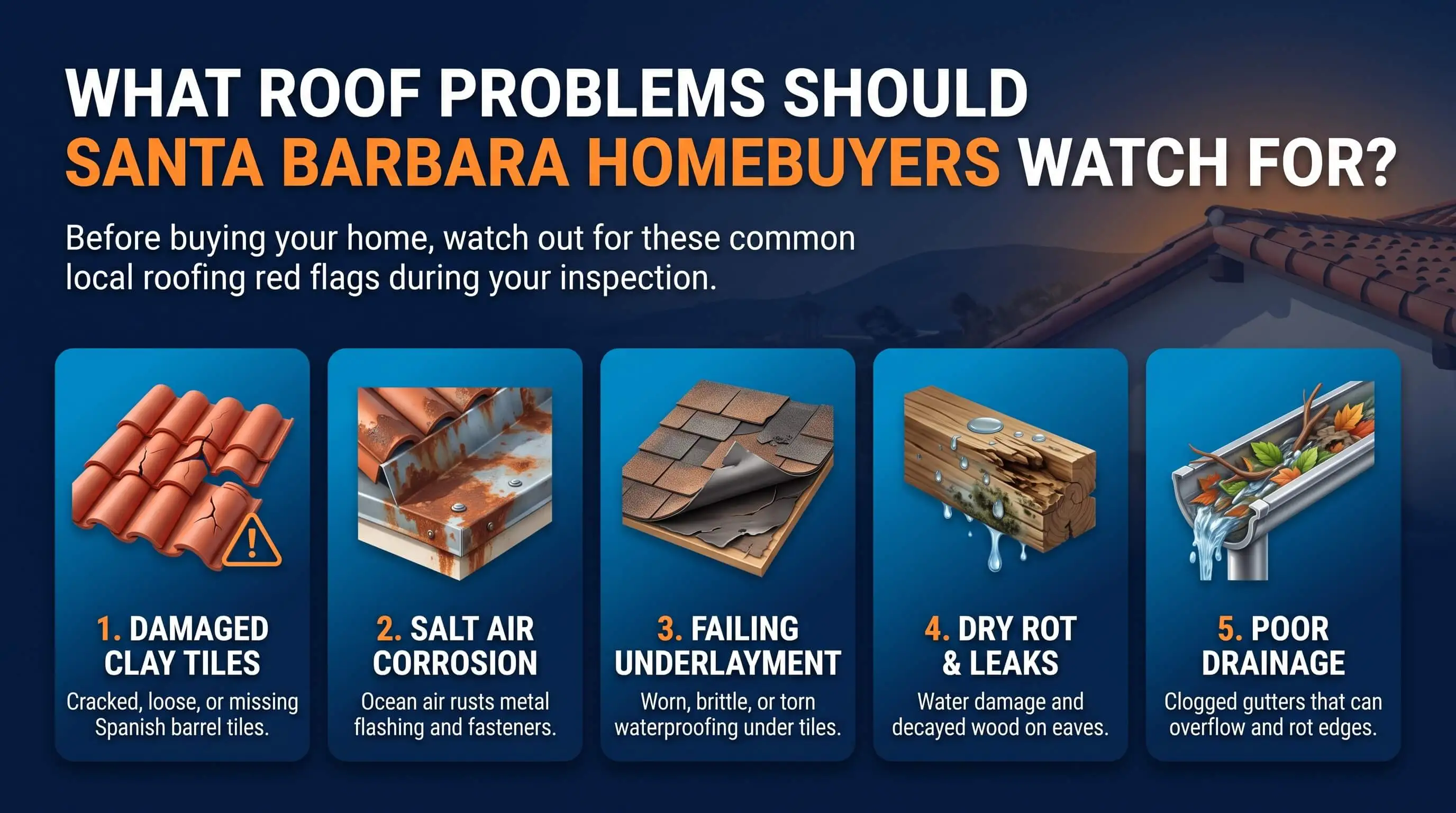
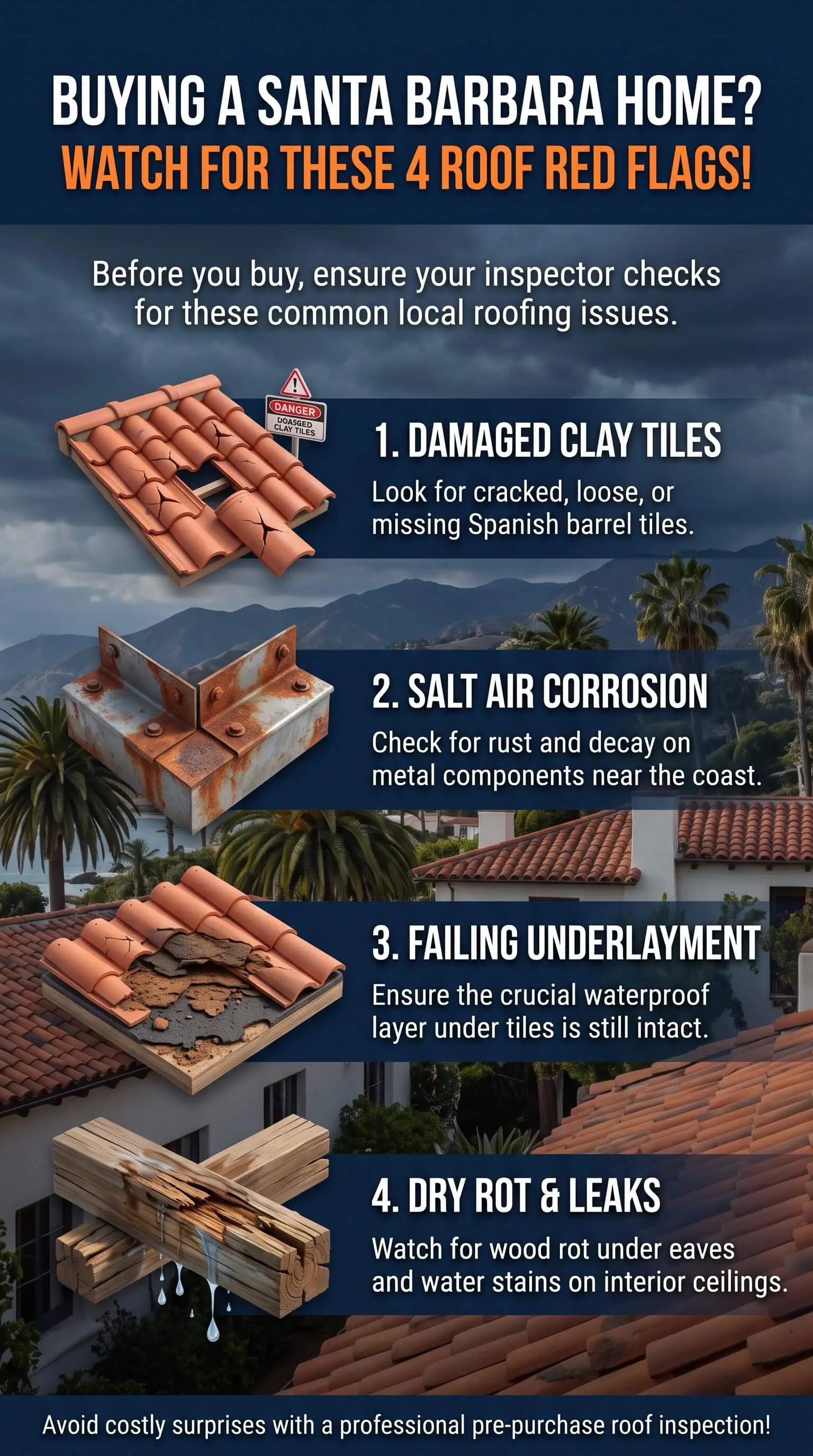
Tile roofs deserve a closer look. Clay and concrete tiles can outlast the people who installed them, but the underlayment beneath them won't. We regularly lift tiles on Spanish-style homes that look flawless from the street and find paper underneath that's gone brittle or torn. Fixing it means pulling the tiles, replacing the underlayment, and resetting everything, so it's not a weekend repair.
Here's what tends to fail first on each roof type we work on:
Clay or concrete tile: Underlayment goes first, followed by broken or slipped tiles and flashing where the roof meets a wall. Ask the seller when the underlayment was last replaced.
Asphalt shingle: Our sun strips granules and curls shingles faster than you'd expect. Ask what year it was installed and whether there's a permit.
Flat or low-slope: Watch for ponding water and failed seams in the membrane. Ask when the membrane or coating was last redone.
Wood shake: Fire-code compliance is the big issue here, along with shakes that have dried out and split. Ask whether the home sits in a High Fire Hazard Area.
Does the Roof Meet Santa Barbara's Fire Rules?
If the home is in one of the city's High Fire Hazard Areas, any roof repair or replacement has to use Class A or noncombustible fire-retardant roof coverings, and wood shakes aren't allowed at all. You'll find those rules in the City of Santa Barbara's high fire construction requirements. Buy a house with an older roof that doesn't comply, and the cost of bringing it up to standard becomes yours the day you close.
The roof's rating can also change how easily you can insure the home. Call your insurance agent before you release your contingencies and ask directly whether the roof's age, material, or fire rating will affect your coverage or premium.
Which Leak and Drainage Red Flags Can You Spot Yourself?
You don't need a ladder to catch a lot of warning signs. Walk the house with this list:
Water stains, bubbling paint, or a suspiciously fresh patch of paint on a ceiling or upper wall
Daylight or damp spots in the attic, especially near vents and chimneys
Rusted, lifted, or heavily caulked flashing around chimneys, skylights, and walls
Cracked, slipped, or mismatched tiles, or shingles that curl and shed granules
Gutters that sag, overflow, or pull away from the fascia
Standing water or patched seams on any flat section
A sagging roofline or soft spots underfoot, which can mean the decking is damaged
That fresh paint deserves a direct question. Sometimes the owners just repainted a room. Sometimes they painted over a leak.
How Does the Roof Affect Your HVAC, Attic, and Indoor Air?
Your roof and your HVAC system share real estate. In plenty of Santa Barbara homes, ductwork and air handlers live in the attic, and some homes have equipment sitting right on the roof. A slow leak can soak insulation, rust equipment, and give mold exactly the damp, dark space it needs. If the attic smells musty, ask about the home's leak history and consider professional air duct mold remediation before you move in.
Ventilation is the other half of the story. A poorly vented attic holds heat, which makes your air conditioner work harder and cooks the roof from below. In a fire country, vents are also an entry point. Research from the Insurance Institute for Business & Home Safety found that wind-blown embers are the main cause of building ignitions during wildfires, and attic vents rank among the most vulnerable openings. Ask whether the home has ember-resistant vents. While you're up there, check the attic insulation as well. If the house has had leaks, indoor air quality testing will tell you what you'd actually be breathing.
Why Isn't a Home Inspection the Same as a Roof Inspection?
A general home inspector has the whole house to cover in a few hours, so the roof gets a limited look. Many won't walk steep, tile, or two-story roofs, and for good reason, since tiles break underfoot and falls happen. They'll often check from a ladder, the ground, or a drone, then write "recommend further evaluation by a licensed roofer."
Take that line seriously. A roofer who works on local homes every week knows how our tile roofs are built, where coastal houses tend to leak, and which fire-zone rules apply. For an independent look before you close, call a licensed contractor who specializes in roofing Santa Barbara properties and ask for a written, itemized report with photos.
How Do You Use Roof Findings to Negotiate?
A documented roof problem gives you leverage while your contingency period is still open. You can ask the seller to make repairs before closing, request a credit, negotiate the price down, or walk away if the roof needs more than you're willing to take on.
Opinions don't move negotiations, but line items do. A written scope of work with real costs gives your agent something concrete to put in front of the seller, and it gives you an honest budget if you decide to buy anyway.
"The roof that worries me most during a sale isn't the one that looks bad. It's the beautiful clay tile roof where nobody's touched the underlayment in decades. From the street it looks perfect, and the tiles themselves might have plenty of life left. Then we lift a few and find the paper underneath dried out and cracked, and the only thing keeping water out is a string of dry winters. So I tell every buyer the same thing. Don't judge a tile roof by the tile. Ask when the underlayment was last replaced, ask to see the permit, and have a roofer look underneath before you sign off on your contingencies. That one question has saved our customers more money than anything else we check."
7 Essential Resources
These are the sources we send Santa Barbara buyers to most often, from local fire rules to a quick way to vet a contractor.
1. City of Santa Barbara High Fire Construction Requirements
City of Santa Barbara: High Fire Requirements (CBC Chapter 7A)
This is the rulebook for roofs in the city's High Fire Hazard Areas, covering Class A coverings, the wood-shake ban, eaves, and attic vents. Read it before you assume an older roof can just be patched.
2. CAL FIRE Fire Hazard Severity Zones
CAL FIRE Office of the State Fire Marshal: Fire Hazard Severity Zones
Plug the address into the state's map viewer. The zone affects building requirements, seller disclosures, and what any future reroof will need.
3. CAL FIRE Ready for Wildfire: Hardening Your Home
Ready for Wildfire: Hardening Your Home
CAL FIRE calls the roof the most vulnerable part of a house in a wildfire. This page walks through roofing materials, sealing gaps under tile, vent screening, and gutter cleanup in plain language.
4. IBHS Research on Ember Entry Through Vents
Insurance Institute for Business & Home Safety: Vulnerability of Vents to Wind-Blown Embers
If the home backs up to brush or sits in the foothills, read this one. It explains why the vents matter as much as the roof covering.
5. CSLB License Check
Contractors State License Board: Check a License
Look up any roofer's license status and complaint history before they set foot on the roof. It takes about a minute.
6. InterNACHI Estimated Life Expectancy Chart
InterNACHI: Standard Estimated Life Expectancy Chart for Homes
This chart lists typical service lives for roofing materials and underlayment. Line it up against the install date on the permit and you'll have a realistic sense of how many years are left.
7. EPA Guide to Mold, Moisture, and Your Home
U.S. EPA: A Brief Guide to Mold, Moisture and Your Home
Roof leaks are one of the most common sources of hidden moisture. The EPA's guide covers why controlling moisture is how you control mold, and when your HVAC system may need attention too.
3 Statistics
1. Tile Can Last 100+ Years, but Felt Underlayment Lasts 15 to 30
InterNACHI's life expectancy chart rates clay and concrete roofing at 100+ years. Black felt paper, the traditional underlayment under many older tile roofs, is rated at 15 to 30.
What this means for buyers: On a tile roof, the tile is rarely what fails. The layer underneath can wear out several times over during the tile's life, so ask when it was last replaced.
Source: InterNACHI's Standard Estimated Life Expectancy Chart for Homes
2. Embers Can Cause Up to 90% of Wildfire Home Ignitions
An IBHS research engineer reported that wind-blown embers are the leading cause of home fires during wildfires and can account for up to 90% of ignitions.
What this means for buyers: A Class A roof covering is essential, but members find other ways in. Gaps under tile, leaves in the gutters, and unscreened attic vents all give them a path.
Source: ENR: Wildfire Protection Tests Focus on the Details of Construction
3. Dry Water Damage Within 24 to 48 Hours to Prevent Mold
The U.S. Department of Energy advises drying water-damaged areas completely within 24 to 48 hours to prevent mold growth, and it lists leaking roofs among the common ways moisture gets into a home.
What this means for buyers: A leak that went unnoticed for weeks may have left mold in the attic, the insulation, or the ducts. Ask about past leaks and how fast they were dried out.
Source: U.S. Department of Energy: Mold and Rot Brief Guide to Mold, Moisture and the Home
Final Thoughts and Opinion
In Santa Barbara, a roof's paperwork tells you more than its curb appeal. We've walked plenty of roofs that looked picture-perfect and turned out to be near the end of their working life, out of step with the fire code, or hiding years of slow leaks. The buyers who avoid those surprises are the ones who get the install date, permit, and fire rating in writing, then find out what's under the tile.
Our honest view is that a general home inspection is a good start and a poor finish. Roofs here deal with salt air, strong sun, the occasional brutal storm, and wildfire rules that keep tightening. A dedicated roof inspection costs far less than most roof repairs, and it gives you leverage at the one point in the deal when you still have it.
And remember what the roof is protecting. Your attic, insulation, ductwork, and often your HVAC equipment all sit under it, so a healthy roof keeps your air cleaner and your systems running longer. In most home purchases, it's one of the biggest calls you'll make.
Frequently Asked Questions
How long do roofs last in Santa Barbara?
That depends on the material and how well it's been cared for. InterNACHI puts 3-tab asphalt shingles at about 20 years, architectural shingles at about 30, and clay or concrete tile at 100+. Our sun and coastal air can shave years off those numbers, and a tile roof will still need its underlayment replaced along the way.
Should I get a separate roof inspection when buying a home in Santa Barbara?
In most cases, yes. General inspectors often check steep, tile, or two-story roofs from a ladder, the ground, or a drone instead of walking them. A licensed roofer can look under tiles, at the flashing, and inside the attic, then give you a written estimate for anything that needs work.
Do I need a Class A roof in Santa Barbara?
If the home sits in one of the city's High Fire Hazard Areas, roof repairs and replacements must use Class A or noncombustible fire-retardant coverings, and wood shakes aren't permitted. Look up the property's fire hazard zone and confirm the current roof's rating before you close.
Can I ask the seller to repair or replace the roof before closing?
You can, and a documented roof report makes the request much harder to brush off. The usual outcomes are seller-completed repairs, a credit at closing, or a lower price. Your real estate agent can tell you which approach fits your contract and timeline.
How do I know if a tile roof needs new underlayment?
Usually you can't tell from the ground. Warning signs include leaks or stains with no broken tiles in sight, an older roof with no record of underlayment work, and brittle or torn paper when a roofer lifts a few tiles. A roofer's inspection is the only reliable way to know.
Can roof problems affect my HVAC system and indoor air?
Yes. A leak can soak insulation, damage ducts or equipment in the attic, and create the moisture mold needs to grow. Poor attic ventilation traps heat and makes your air conditioner work harder. If the home has a leak history, have the attic and ducts checked before you move in.
Know Your Roof Before You Close
Before you sign, let us take a close look at the roof you're about to own. Quality Roofing of Santa Barbara has been roofing in Santa Barbara, Goleta, Montecito, and the surrounding communities since 1996, and we offer free on-site estimates with a clear, itemized scope. We treat every roof as if it were our own, so you'll know exactly what you're buying, and you'll have the facts in hand if it's time to negotiate. The same goes for other major home systems, including HVAC system installation—knowing their condition and potential costs before closing can help you avoid expensive surprises later.